Fintech · Global (North America & Europe Focus) · 1 Year
How a B2SMB Fintech SaaS 5x’d ARR While Cutting CAC by 44% in 11 Months
Client Overview
Increase qualified pipeline, reduce blended CAC, and drive material ARR growth by turning underperforming SEO and previously unprofitable Google Ads into a scalable, efficient demand engine
5× ARR and −44% CAC for B2SMB Fintech SaaS
This B2SMB fintech SaaS had strong product‑market fit at $5M ARR but rising CAC, failing SEO, and Google Ads turned off after painful CPCs. We deployed the Vicious Marketing OS to rebuild their go‑to‑market: focused ICP and messaging, profitable paid search, fintech‑specific SEO, and a tighter funnel-driving ARR to about $25M in under a year.
How We Applied the Vicious Marketing OS
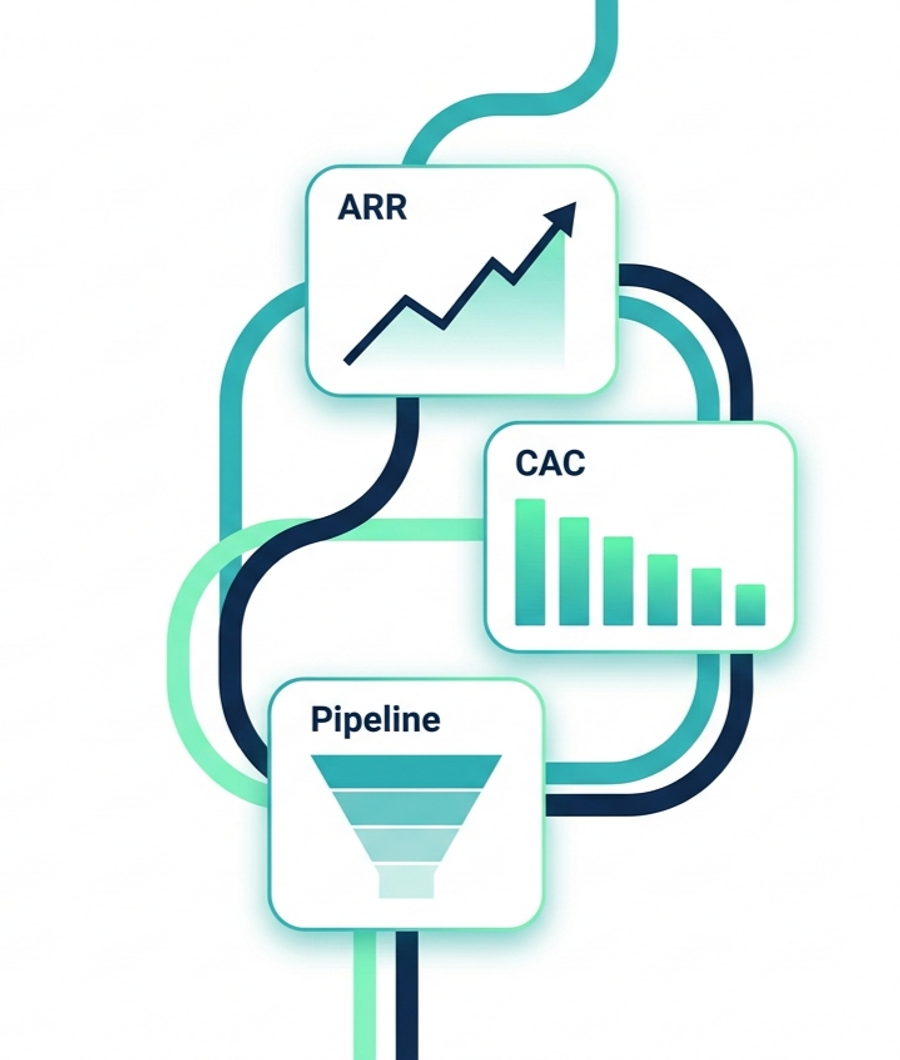
We partnered with a B2SMB fintech SaaS at roughly $5M ARR to build a growth operating system instead of another short‑lived campaign. First, we sharpened their ICP and messaging around clear financial outcomes for small and mid‑sized businesses. Then we rebuilt Google Ads from the ground up, focusing on high‑intent search terms, strict negative keywords, and offline conversion tracking into the CRM so bids were optimized for pipeline and ARR, not just clicks. In parallel, we replaced generic SEO activity with a fintech‑specific content and technical strategy designed to capture bottom‑ and mid‑funnel demand. Finally, we simplified the trial and onboarding flows, added product‑led “aha” moments, and wired everything into weekly growth sprints, giving leadership clear visibility into CAC, trial‑to‑paid conversion, and ARR impact.
The Challenge
Despite solid ARR and happy customers, growth was hitting a ceiling.
The board mandate, stated explicitly in the Q1 board meeting, was: "We need to 3× pipeline volume within 12 months, reduce blended CAC below $3,500, and demonstrate that we have a repeatable, channel-diversified growth engine before the next raise." There was no ambiguity. The existing approach was not going to get them there.
Board‑level objectives
- Increase volume of qualified pipeline
- Reduce blended CAC and improve unit economics
- Drive material ARR growth in the next 12 months
Key problems
1. High and rising CAC ($5,000)
Acquiring each new customer required significant spend across fragmented channels. The team lacked clarity on which activities truly drove efficient revenue.
2. Google Ads switched off
Previous paid search campaigns produced very high CPCs and weak opportunity creation. At the point the channel was paused, CPCs were running between $28 and $74 per click on core product terms, with cost-per-SQL exceeding $4,200 and almost no closed-won revenue attributable to the channel over a 4-month test period. The conclusion: “Google Ads is too expensive for our market,” so the channel was paused entirely.
3. Underperforming SEO
SEO was outsourced to an agency, but results were poor. The site was receiving approximately 3,400 monthly organic visits at engagement start, with zero pipeline attributed to SEO in the prior 6 months. The agency had published 22 blog posts in that period, none of which ranked for any commercial-intent keyword.
- Content was generic and not aligned with fintech SMB buying journeys
- There was no visibility from keyword to traffic to pipeline to ARR
- Organic contributed little to sales‑qualified pipeline
4. No unified growth operating system
Marketing, sales, and product were running separate initiatives. Campaigns were reactive and channel‑by‑channel, without a single system tying efforts to pipeline, CAC, and ARR.
Bottom line
The company had product‑market fit, but not a scalable, efficient growth engine.
3. Why They Chose Vicious Marketing OS
The leadership team did not want another set of isolated tactics. They wanted a repeatable way to:
- Turn previously “too expensive” channels into profit centers
- Make SEO and paid accountable to pipeline and ARR
- Align marketing, sales, and product around shared metrics
The Vicious Marketing OS offered a structured, closed‑loop growth system rather than one‑off campaigns.
4. Our Approach: Implementing the Vicious Marketing OS
4.1 ICP and Messaging: From “Any SMB” to Ideal B2SMB Fintech Buyers
We began by tightening who we were trying to acquire and why.
- Defined a clear B2SMB ICP: priority industries, company sizes, tech stacks, and triggers that made the product most valuable
- Reframed messaging around measurable financial outcomes, such as reducing reconciliation time, lowering payment errors, and improving cash‑flow visibility
- Standardized value propositions across landing pages, ad copy, outbound sequences, and lifecycle campaigns
What didn't work initially: Our first messaging framework leaned heavily on "automation" as the lead value proposition. Early landing page tests showed weak conversion. Visitors understood what the product did, but not why it mattered to them financially. We shifted the primary message from feature-led ("automate your payments") to outcome-led ("cut reconciliation time by 80% and close your books 3 days faster"). That change alone lifted landing page CVR by over 30% before a single ad dollar was reallocated.
Impact
Higher relevance and resonance across channels, improved click‑through rates, and better‑qualified opportunities entering the funnel.
4.2 Google Ads: From “Too Expensive” to Scalable Profit Center
Instead of abandoning Google Ads, we rebuilt it from the ground up with a fintech‑specific strategy.
- Created tight keyword clusters focused on high‑intent product and problem queries, not broad “fintech software” terms
- Built and maintained robust negative keyword lists and weekly search term reviews to cut wasted spend
- Integrated Google Ads with the CRM using offline conversion tracking, so bidding strategies optimized for sales‑qualified opportunities and closed‑won deals rather than just form fills
- Adjusted bids, match types, and ad groups to concentrate budget in segments with proven pipeline and ARR impact
What didn't work initially: In the first three weeks of the rebuilt campaigns, we attempted to run broad-match modified keywords to gather signal quickly. The volume was there, but the quality was not, we were attracting a high proportion of solopreneurs and very early-stage businesses outside the ICP. We shifted to exact and phrase match exclusively for the first 60 days, accepted lower volume, and used that period to build the negative keyword library. Only once we had clean signal did we cautiously reintroduce broader match types with aggressive negative controls.
Impact
- CPCs dropped to acceptable levels
- Google Ads became a predictable, scalable source of SQLs and revenue instead of a sunk cost
4.3 Fintech‑Focused SEO: From Activity to Pipeline Driver
We replaced the generic SEO program with a focused, revenue‑linked fintech SEO strategy.
- Prioritized bottom‑ and mid‑funnel topics with clear commercial intentUse‑case and solutions pages for specific SMB verticals“How to” guides around core financial workflows solved by the productComparison and “vs alternative” pages
- Use‑case and solutions pages for specific SMB verticals
- “How to” guides around core financial workflows solved by the product
- Comparison and “vs alternative” pages
- Mapped keywords to funnel stages and built content explicitly designed to create pipeline, not just traffic
- Resolved technical SEO issues including page performance, internal linking, and crawlability
- Coordinated SEO content with paid campaigns so prospects encountered consistent messaging across search and the website
What didn't work initially: Our first round of comparison pages ("Product X vs Competitor Y") were written too neutrally in an attempt to appear objective. They attracted traffic but converted poorly. We rewrote them to be direct and opinionated, clearly stating who the product was best for, who it wasn't, and why. And added a strong CTA tied to a free trial with a specific outcome promise. Conversion on those pages more than doubled after the rewrite.
Impact
- High‑intent organic traffic grew significantly
- SEO became a low‑CAC, high‑quality demand channel and a meaningful contributor to new pipeline
4.4 Funnel and Product‑Led Optimization
Because SMB buyers are sensitive to friction, we optimized the entire journey from click to paying customer.
- Simplified the signup flow to reduce steps and highlight the value proposition early
- Designed in‑app onboarding paths that drove users quickly to their “aha moment,” such as first integration or first successful transaction
- Implemented behavior‑based lifecycle journeys to re‑engage dormant trials and prompt expansion when usage signaled upgrade potential
What didn't work initially: The first version of our re-engagement email sequence for dormant trials was generic; a "come back and see what's new" message. Open rates were acceptable, but reactivation was near zero. We rebuilt the sequence to trigger based on specific in-app behavior gaps (e.g., users who had signed up but never connected a bank account received a targeted guide on doing exactly that). That behavioral segmentation lifted trial reactivation by approximately 3×.
Impact
- Trial‑to‑paid conversion rate increased substantially
- Pipeline velocity improved, and each acquired customer generated more ARR over time
4.5 Closed‑Loop Measurement and Weekly Growth Sprints
To make the Vicious Marketing OS a living system, we established tight feedback loops.
- Unified data from Google Ads, SEO, outbound, and product usage into a single reporting framework
- Measured CAC and ARR by channel and key campaign, not just traffic or leads
- Ran weekly growth sprints focused on:Cutting underperforming spendScaling winning campaignsLaunching new experiments with clear hypotheses and success metrics
- Cutting underperforming spend
- Scaling winning campaigns
- Launching new experiments with clear hypotheses and success metrics
What didn't work initially: In the first month, weekly sprint reviews were attended by marketing only. Decisions were made in isolation and often contradicted what the sales team was seeing in conversations. We restructured the weekly sprint to include a sales lead and a product representative. The quality of decisions improved immediately. Within two weeks of that change, we identified that a high-performing ad segment was generating demos that consistently didn't close because of a pricing misalignment, something marketing data alone would never have surfaced.
Impact
- Leadership gained clear visibility into what was driving efficient growth
- The team moved from reactive campaigns to a disciplined test‑and‑scale rhythm
5. Results
5.1 Headline Outcomes (11 Months)
- ARR grew from approximately $5M to around $25M (5× increase) – Verified by client CFO.
- Blended CAC dropped from roughly $5,000 to approximately $2,800 (44% reduction) – Verified by client CFO.
- Trial‑to‑paid conversion improved from about 11% to 24–26% – Verified against product analytics.
- SEO evolved from negligible impact to contributing roughly 30–35% of new pipeline – Verified by CRM source attribution.
- Google Ads cost per SQL decreased by approximately 40–50%, while maintaining or improving lead quality – Verified against CRM and ad account data.
5.2 ARR Growth Trajectory
The $20M ARR increase was not linear. Here is how growth compounded across the engagement:
Month 1–2 (Foundation): $5M ARR. ICP and messaging work underway. No material channel changes yet.
Month 3–4 (Early Signal): $7M ARR. Google Ads rebuilt campaigns generating first SQLs. SEO infrastructure in place.
Month 5–6 (Acceleration Begins): $11M ARR. SEO content ranking for commercial terms. Paid search scaling. Funnel optimization underway.
Month 7–8 (Compounding): $16M ARR. SEO now contributing meaningful pipeline. Trial-to-paid conversion improvements taking effect.
Month 9–10 (Scale): $21M ARR. All channels operating in a closed loop. CAC below $3,000 for the first time.
Month 11 (Exit Point): $25M ARR. Blended CAC at $2,800. Growth engine operating as a self-reinforcing system.
5.3 Channel Attribution
Of the approximately $20M in net new ARR generated during the engagement, attribution broke down as follows:
Google Ads (rebuilt): 35% of new ARR SEO (organic search): 30–35% of new ARR Outbound / sales-assisted: 20% of new ARR Product-led / referral / other: 10–15% of new ARR
Note: These figures reflect closed-won revenue attribution as tracked in the CRM, using a last-meaningful-touch model validated with the client's revenue operations team.
5.4 Before / After Comparison
ARR (run-rate)- Before: $5M → After: $25M (5× growth)
Blended CAC- Before: $5,000 → After: $2,800 (44% reduction)
Trial-to-Paid Conversion- Before: 11% → After: 24–26%
SEO Share of New Pipeline- Before: Minimal → After: 30–35%
Google Ads Cost per SQL- Before: Paused – too high to scale → After: 40–50% lower, strong quality
Organic Monthly Visits- Before: 3,400 → After: 18,000+
Paying SMB Customers- Before: 850 → After: 2,000+
6. Client Perspective
"Honestly, I was skeptical. We'd been burned by agencies that promised pipeline and delivered PDF reports. When Vicious Marketing OS told us they could make Google Ads work for us, I thought, we tried that, it doesn't work in our market. I was wrong. What I didn't expect was how fast the SEO started converting. Within five months, we were getting demos booked from organic search that our sales team said were some of the best-qualified leads they'd seen. That was the moment I became a believer." – Founder & CEO
What they were skeptical about going in: The team did not believe Google Ads could ever be cost-efficient for their ICP. They had also grown cynical about SEO after a year of agency work that produced traffic but zero pipeline. There was an internal debate about whether to invest further in either channel at all.
What surprised them most: The speed at which SEO became a pipeline driver, faster than any of the leadership team expected, and the degree to which tightening the ICP definition improved results across every channel simultaneously, not just messaging. The CEO noted in a month-9 review: "We didn't just fix our marketing. We got clearer on who we are as a company."
7. Key Lessons for B2SMB Fintech SaaS Companies
- Product‑market fit is not enough: You need a repeatable growth operating system that connects channels directly to revenue. This company had strong retention and a product customers loved, but was still stuck at $5M ARR because there was no system connecting marketing spend to pipeline to ARR. The OS was what unlocked compounding growth.
- Google Ads is not inherently too expensive: it is expensive when misstructured. At $28–74 CPCs with no CRM integration, the channel was burning cash. Rebuilt with offline conversion tracking and ICP-specific keyword clusters, it became the single largest contributor to new ARR within four months.
- SEO must be measured by pipeline and ARR, not rankings or traffic: The previous agency generated 3,400 monthly visits and zero pipeline. The replacement strategy generated fewer early visits but began attributing 30–35% of new opportunities within six months by focusing exclusively on commercial-intent topics.
- Aligning marketing, sales, and product around shared growth metrics changes the quality of decisions. The single structural change of adding a sales lead and product representative to weekly growth sprints surfaced a pricing misalignment that no amount of marketing data would have caught. That change alone saved significant wasted spend.
- Iteration speed compounds: The weekly sprint model meant the team ran and evaluated dozens of experiments across 11 months. The wins: behavioral re-engagement, opinionated comparison pages, outcome-led messaging, each felt small in isolation. Combined, they produced a 5× ARR outcome.
7. About Vicious Marketing OS
The Vicious Marketing OS is a growth operating system for B2B and B2SMB SaaS companies. It is designed to:
- Turn underperforming or abandoned channels into scalable profit centers
- Make SEO and paid media accountable to the pipeline and ARR
- Align marketing, sales, and product teams around one shared growth model and measurement framework
We specialize in working with SaaS and fintech companies from roughly $1–2M ARR and up who are ready to scale in a capital‑efficient way.
8. Things to Consider
- Who this is for: This conversation is designed for B2B and B2SMB SaaS founders, CEOs, or CMOs who are between $1M and $15M ARR, have demonstrated product-market fit, and are ready to build a growth engine that is accountable to pipeline and ARR, not vanity metrics.
- Who this is NOT for: If you are pre-product, pre-revenue, or looking for a quick-hit paid media agency to run ads in isolation, this is not the right fit. The Vicious Marketing OS is a system engagement, not a campaign retainer.
- What the strategy session includes: A focused 45-minute working session, not a pitch call, where we will review your current funnel metrics, CAC by channel, and ARR targets. You will leave with a written assessment of your highest-priority growth constraints and a prioritized OS roll-out plan specific to your stage and market. There is no obligation and no pitch. If there is no clear fit, we will tell you.
- No obligation. No pitch. If we are not the right partner for where you are, we will say so directly.