ROAS vs CAC: Why Strong ROAS Still Hides a Pipeline Problem

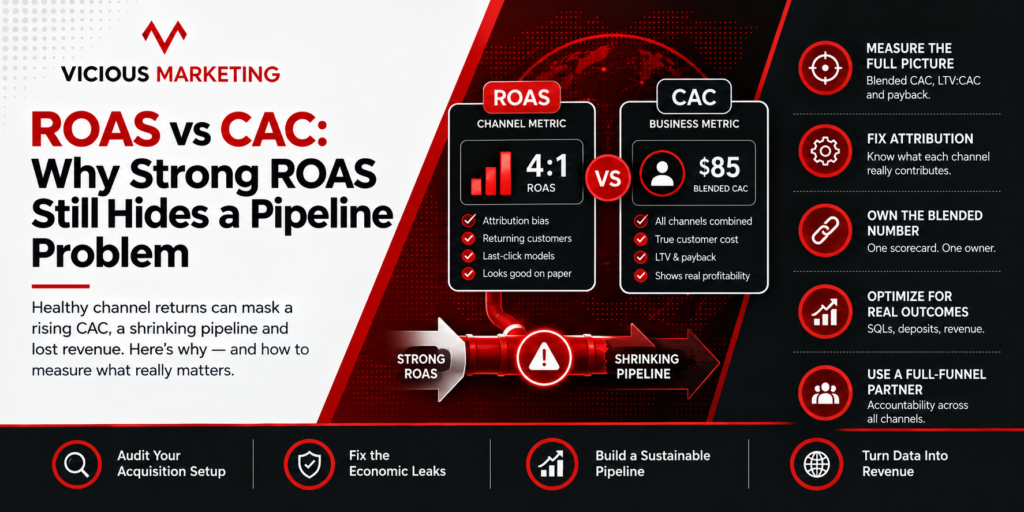
ROAS vs CAC is the argument behind many tense marketing meetings: the paid dashboards show healthy returns, yet pipeline and revenue are not moving, and leadership wants answers. The reason is simple. ROAS measures a single channel in isolation, while CAC measures the business. A channel can look excellent on its own report while the company pays more for every customer it wins. This post explains why the two metrics disagree, which one to trust, and how to close the gap.
ROAS vs CAC: What Each One Actually Measures
ROAS (return on ad spend) is the revenue a single channel is credited with for each dollar spent on its ads. CAC (customer acquisition cost) is what it really costs to win a customer. Blended CAC takes all sales and marketing spend across every channel and divides it by the new customers won.
The difference is scope. ROAS answers “is this channel earning more than it costs, by its own count?” CAC answers “what does a customer cost us across everything, and is that sustainable?” The first is a channel metric. The second is a business metric. Strong ROAS only proves the first.
Why Strong ROAS Can Still Mean a Shrinking Pipeline
1. ROAS Counts Attributed Revenue, Not New Pipeline
A ROAS figure counts revenue the platform attributes to the ads, and that revenue is not always new. It can include returning customers who were already going to buy, or deals the sales team would have closed anyway. The dashboard shows a strong return while the count of genuinely new customers and opportunities stays flat.
2. It’s Reported Per Channel, So No One Owns the Blended Number
Search reports its ROAS, paid social reports its own, and email and affiliates report theirs. Each can look healthy. But nobody owns the combined cost of winning a customer, so a rising blended CAC has no owner and goes unexplained until it shows up in the P&L.
3. Platform-Reported ROAS Over-Credits Itself
Ad platforms measure their own results, usually with last-click or similar models, and they tend to claim credit for conversions they only touched at the end. When two platforms both claim the same sale, reported ROAS adds up to more revenue than the business actually booked. Branded search and retargeting look especially strong because they capture demand that other channels created.
4. High ROAS on Low-LTV Customers Still Loses Money Over Payback
ROAS looks at the first order or deposit. It says nothing about whether the customer stays. A channel can deliver an impressive return on the first purchase and bring in customers who churn within weeks. Measured over the payback window, those customers cost more than they ever return. The dashboard says win. The cash flow says otherwise.
To make this concrete, here is an illustration with hypothetical numbers. A channel reports a 4:1 ROAS. But if a quarter of that attributed revenue came from existing customers and the new ones churn quickly, the real return on new customers is far lower, and blended CAC rises even as the channel report stays green.
The Metric That Tells the Truth: Blended CAC and Payback
If ROAS is the channel view, the board-level view is built from three numbers: blended CAC, LTV:CAC and the payback window.
Blended customer acquisition cost shows what a new customer costs across all channels combined. LTV:CAC compares what a customer is worth over their lifetime with what it cost to win them. A common rule of thumb is about 3:1, though it varies by business. The payback window shows how many months it takes to recover that cost from the customer’s margin, which tells you how long your cash is at risk.
Together, these answer the questions leadership actually asks. Are we winning customers profitably? How fast does the money come back? Can we afford to scale? ROAS alone answers none of them.
Why This Happens With Most Agencies
The problem is structural. Most channel agencies are hired to run one slice of acquisition, such as search, social or affiliates. They optimize that slice and report on it, usually using the platform’s own ROAS, because that is the number they can see and control.
When blended CAC rises, each agency can point to its own healthy report and say the issue lies elsewhere. Nobody is wrong within their scope, and nobody is responsible for the whole. That is why strong channel reports and a weak pipeline can coexist for months.
A performance marketing agency that owns the full picture removes this gap, because accountability sits with the combined result, not with individual channels.
How to Fix It: Report on What the Board Sees
The fix is to change what you measure and who owns it. It has three steps.
Fix attribution. Start by establishing what each channel really contributes, including which create demand and which only capture it. Reliable attribution depends on clean tracking and joined-up data, so that the numbers reconcile with actual bookings.
Roll channels into one blended CAC and payback model. Put every channel on a single scorecard that shows the combined cost of winning a customer and how fast it pays back. This gives the whole business one number to manage.
Optimize for SQLs or deposits, not channel ROAS. Set targets on the outcomes that matter to revenue: qualified sales opportunities, or first-time deposits in regulated markets such as iGaming and CFD/forex. In one UK casino program, cost per first deposit fell 18%, from $170 to $139.40 by month five, while first-time depositors rose from about 3,000 to 3,659 a month on unchanged spend.
This is how the VM Operating System works: Diagnose where the economics leak, Engineer the fixes, then Scale with every channel held to one CAC target.
See your true blended CAC: book a free Acquisition Teardown.
Prefer to start with the framework? Get the Regulated Market Acquisition Playbook.
FAQ
What’s the difference between ROAS and CAC?
ROAS measures the revenue a single channel is credited with for each dollar of ad spend. CAC measures what it costs to win a customer, and blended CAC does so across all channels. ROAS is a channel metric, while CAC is a business metric.
Is ROAS or CAC more important?
CAC, together with LTV and payback, matters more at the business level, because it shows whether customers are being won profitably. ROAS is still useful for managing a channel day to day, but it should be read alongside blended CAC, never in place of it.
What is a good ROAS or a good CAC?
There is no universal number for either. A good ROAS depends on your margins, and a good CAC depends on customer lifetime value. A common rule of thumb is an LTV:CAC ratio of about 3:1 with payback inside 12 months, though both vary by industry and model.
Why is my ROAS high but revenue flat?
Usually because ROAS counts attributed revenue, not new pipeline. Platforms over-credit themselves, returning customers inflate the figure, and low-LTV customers may not pay back. Check blended CAC, new customer counts and payback to see what ROAS is hiding.