The Enterprise SEO Platform Features Checklist: 12 Capabilities to Demand Before You Sign

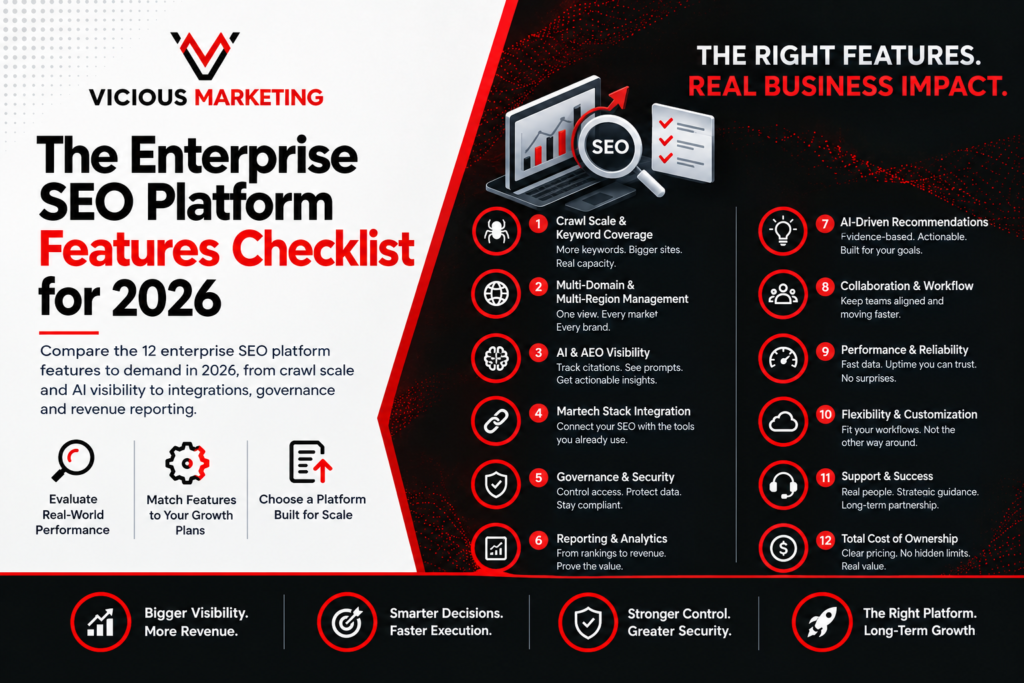
Enterprise SEO platforms look impressive in a sales demo. The dashboard is clean, the reports load instantly and every feature seems useful. The real test comes later, when you add another market, crawl the full website or move the data into your existing systems.
The best enterprise SEO platform features are the ones that keep working as your websites, team and reporting needs grow. Use this enterprise SEO platform checklist to look past the presentation and test how the software will work inside your organization.
Crawl Scale and Keyword Coverage
Scale sounds straightforward until a vendor defines it differently from you. An enterprise contract can still limit keywords, pages or crawls.
1. Keyword tracking with room to grow
Start with your current keywords, then add planned products, countries, languages and competitors. Check how location and frequency affect usage. One keyword monitored daily in ten markets may consume far more allowance than a weekly check in one country.
Some comparisons describe seoClarity as having no per-keyword caps, yet its pricing still depends on query volume. Ignore the word “unlimited” until you know how many queries your contract covers, how often they refresh and what happens when you exceed them.
2. Crawl capacity that matches your real website
A crawler that handles a 50,000-page corporate site may struggle with 800,000 product and category URLs. Botify and Lumar support sites with hundreds of thousands or millions of pages, but the headline limit does not show how a crawler will handle your setup.
Ask for a test using JavaScript-rendered pages, filters, parameters and international folders from your site. Check the crawl time, available frequency and whether the platform clearly shows what changed.
Multi-Domain and Multi-Region Management
Enterprise SEO often means managing several websites. Leadership needs a portfolio view, while regional teams need relevant local data.
3. Native multi-domain tracking
If you manage 30 brand sites, opening 30 projects is not portfolio management. You need consolidated reporting and brand comparisons, while each team retains a view of its own website, products and competitors.
A central SEO lead may want to spot which brands lost visibility, while a local manager needs the pages and competitors affecting one market. Both views should use the same data.
Acquisitions and launches can add domains quickly. Confirm whether adding them changes the price, permissions or reporting setup.
4. Regional and multilingual reporting
A global dashboard can hide local problems. The platform should separate performance by country, language, search engine and device without requiring a new instance for every market.
It should handle local keywords, hreflang issues and regional competitors. UK and German teams may sell the same product, but they face different searches and competitors. Each needs a local view, while leadership needs one reliable roll-up.
Combining every market into one average can make a strong country hide a serious decline elsewhere.
AI and AEO Visibility
AI search now appears in almost every platform pitch. Useful tools show where your brand appears, which pages earn citations and what to do next.
5. AI Overview and LLM citation tracking
BrightEdge offers AI Catalyst, Conductor has AI search visibility tracking and seoClarity uses Clarity ArcAI for citations, mentions and sentiment. seoClarity’s Sia assistant supports research and content work, while ArcAI focuses on AI-search visibility.
Confirm which engines the platform monitors, how often it checks prompts and whether citations reach page level. A visibility score is not enough. You should see the prompt, answer, cited source and change over time.
6. Recommendations connected to real evidence
Useful recommendations connect content changes to rankings, citation gaps, search demand or competitor performance. If a platform tells you to “add depth,” it should show what is missing and why it matters.
If a product page loses AI citations, the platform should show what changed, which competitors replaced it and where the page needs attention.
Ask the vendor to review one of your pages during the demo. You will quickly see whether the advice comes from your data or could fit any website..
Martech Stack Integration
Your SEO platform will not work alone. It must connect with the systems used to publish content, manage leads and report performance.
7. CMS and CRM integrations your team can actually use
WordPress, Adobe Experience Manager, Salesforce and HubSpot often appear on integration lists. A familiar logo does not prove the connection supports your workflow. It may be a two-way integration, a limited connector or an export process.
Ask what data moves, how often it syncs and who maintains it. If every field change needs IT support, the integration is not as convenient as it sounds.
8. Open APIs and flexible data exports
SEO data should move into GA4, Looker Studio, Tableau or your data warehouse. Senior teams should not need a separate dashboard when every other channel appears in one reporting environment.
Check API limits, export formats, refresh frequency and historical access. Confirm whether the API is included in your tier. If you leave, you should not lose years of keyword, crawl and performance history.
Governance and Workflow
Agencies, regional marketers, writers, developers and executives need different levels of access. Large organizations cannot manage this informally.
9. Role-based access and single sign-on
Administrators should control who can view, edit and export data. Single sign-on simplifies access when employees join, change roles or leave. Audit logs show who changed settings or reporting rules.
Do not settle for “admin” and “user.” Test permissions against real roles, including agencies and temporary contributors.
10. Content workflows that fit the way you publish
Content briefs and writing assistants can speed up work, but they do not automatically create an approval process. Some tools still rely on the CMS for formal review and publishing.
Map the handoff before buying. Where is the brief created? Where do legal and brand teams comment? Who approves the final version, and how does it reach the CMS? A useful workflow removes copying and status chasing instead of creating another place to check.
Reporting, Revenue Attribution, and Support
SEO teams need ranking detail. Executives need to know whether those rankings produced traffic, pipeline or revenue.
11. Reporting that connects SEO with business results
Executive reports should connect organic performance with conversions, pipeline and revenue using analytics and CRM data.
The platform should explain how it connects an organic visit with an outcome and handles assisted conversions. Revenue numbers are not useful if nobody can explain where they came from.
If organic traffic rises by 20% while qualified demos fall, a rankings-only report misses the difference between more traffic and better commercial performance.
SEO teams need page and query detail. Executives need trends, commercial impact and risks. Regional leaders need local results without losing the global picture.
12. Support that is defined in the contract
A dedicated customer success manager can help during onboarding, but “dedicated support” may mean strategy calls or a shared inbox. Put the meeting cadence, response times, escalation route and training hours in the agreement.
Check the uptime SLA and the remedy if the vendor misses it. Separate included onboarding from professional services. Confirm any help with dashboards, integrations or regional training before signing.
Our SEO enterprise comparison shows how vendors differ in services and coverage. The best contract is the one that matches how your team works.
Frequently Asked Questions
What features should an enterprise SEO platform have that mid-market tools lack?
It should handle larger crawl and keyword volumes, multiple domains, regional reporting, role-based access, SSO, APIs and executive reporting. It should also provide defined onboarding and support. The main difference is managing scale without adding manual work.
Do enterprise SEO platforms include AI and AEO tracking by default?
Not always. AI visibility may sit in the core platform, a higher tier or a separate product. Confirm the engines, prompts and citations covered, data frequency and whether recommendations come with tracking.
What integrations should I require before signing an enterprise SEO contract?
Prioritize your CMS, analytics platform, CRM, BI tools and data warehouse. Ask what information moves through each integration, whether it is native and what technical work your company must maintain.
Is role-based access a standard feature or an add-on?
Role-based access is common, but the depth of control and eligible tier vary. Ask for a demonstration covering administrators, regional teams, agencies and writers. Confirm whether SSO and audit logs cost extra.
How do I evaluate crawl scale before committing to a platform?
Give the vendor a representative sample including the hardest areas to crawl. Test JavaScript, parameters, international pages and large product sections. Measure completion time, freshness and change tracking instead of trusting only the stated page limit.
Evaluating platforms and not sure which capabilities are non-negotiable for your team? [Get a free enterprise SEO platform audit from Vicious Marketing →]