Forex Broker Acquisition Costs Are Rising: Why Changing Your Marketing Team Rarely Fixes It

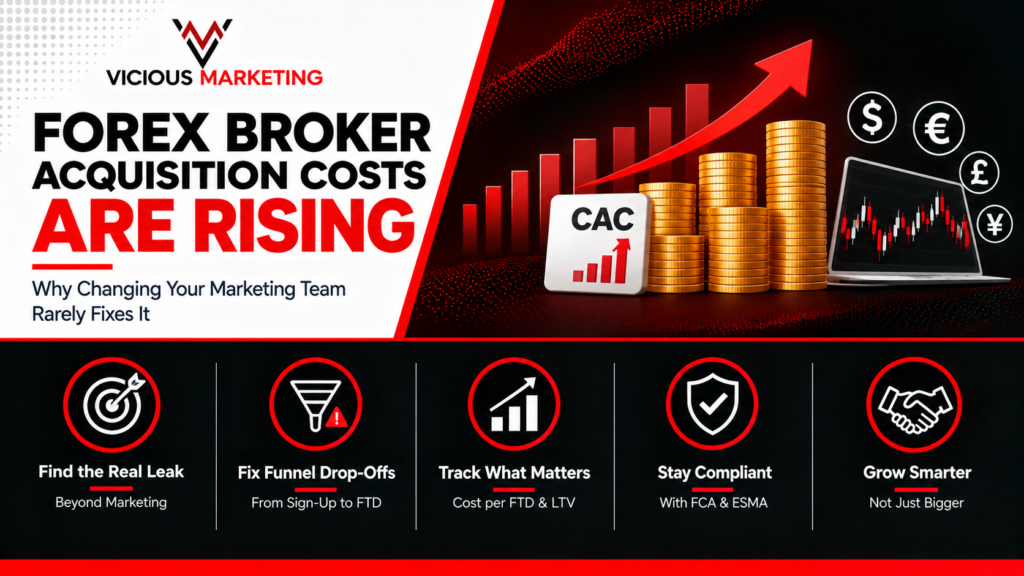
Cost per first-time depositor (FTD) is up again. The reflex is to replace the head of marketing or the agency. Six months later, the cost per FTD is the same.
You’re not the only one stuck in this loop. Finance Magnates recently published a piece on exactly this: CFD brokers changed their marketing teams, but did they fix the wrong problem? (22 Oct 2026). Rising forex broker client acquisition cost is usually a symptom. The leak is often outside marketing, in onboarding, KYC, deposit conversion, tracking or retention. Below are the five places the cost hides, and how to find yours before changing anyone.
Why Forex and CFD Acquisition Costs Keep Rising
Part of this is the market, and it’s worth naming.
More competition for the same traders. Paid search and social bids keep rising as more brokers chase the same audience.
Platform restrictions. Google and Meta financial-services verification, plus ESMA risk warnings, weigh on ad performance and limit how you can write copy.
More reliance on affiliates and introducing brokers (IBs). These partners can cost more and bring weaker leads, especially when they’re paid on volume rather than quality.
On benchmarks, Track360’s 2026 forex broker CAC guide ranks channels by relative cost rather than hard numbers. Cold paid media carries the highest cost per funded account and leaves you holding the conversion risk, affiliate CPA sits in the middle at a predictable price, and IB or revenue-share deals cost least up front. The same guide makes a point worth stealing: calculate CAC as fully loaded acquisition cost divided by funded accounts, not by leads or registrations.
Some of this is the market. A lot of it is inside your funnel.
Why Changing the Marketing Team Rarely Fixes It
A new team inherits the same system. Same funnel, same tracking, same onboarding. It optimises the same broken thing, just with fresh energy.
Ad platforms optimise toward the signal they’re given. If that signal is a registration rather than an FTD, a new team buys cheaper registrations, not cheaper depositors. The dashboard looks better. The deposit numbers don’t.
The truth is, you can’t hire your way out of a measurement problem. For the in-house versus agency trade-off in this sector, You can check our post on forex marketing agencies vs in-house teams.
The 5 Places Your Cost per FTD Is Really Leaking
1. Registration-to-KYC Drop-Off
What it looks like: traders sign up and never verify. Marketing gets credit for the registration, then the lead dies in onboarding.
The metric that exposes it: lead-to-KYC rate.
The fix: shorten the verification path, send reminders that explain what’s needed and why, and make mobile upload painless.
2. KYC-to-First-Deposit Drop-Off
What it looks like: verified accounts that never fund, often because of payment-method friction or no follow-up.
The metric that exposes it: KYC-to-FTD rate.
The fix: offer the payment methods your target markets actually use, and follow up within a defined window. Our CFD broker marketing compliance checklist helps keep that follow-up compliant.
3. Lead Quality by Source
What it looks like: affiliates, IBs and paid channels send very different traders. Blended numbers hide the gap.
The metric that exposes it: cost per FTD and 90-day value per source.
The fix: judge every source on value, not volume. What most people miss is that the cheapest source on paper is often the most expensive once churn is counted.
4. Broken FTD Tracking
What it looks like: deposits never get matched back to the ad or source, so budget flows to the wrong channels and platform algorithms learn from bad data.
The metric that exposes it: share of FTDs with a known source.
The fix: pass source identifiers through registration, KYC and deposit, and feed the FTD event back to your ad platforms.
5. Retention
What it looks like: early churn forces you to reacquire traders, which pushes blended acquisition cost up.
The metric that exposes it: FTD-to-active-trader rate and LTV.
The fix: look at the first 30 days after funding. That’s usually where traders decide whether to stay.
How to Diagnose Your Funnel Before Changing Anyone
A practical four-step check:
- Map the full path: click, registration, KYC, FTD, active trader.
- Put a conversion rate and cost on each step.
- Compare each source against value, not volume.
- Find the single biggest drop, and fix that first.
The fix is usually one or two stages, not the whole team.
Compliance Shapes Every Fix
Any fix has to work within FCA and ESMA rules, CySEC where relevant, and platform financial-services policies. Risk warnings, claims and bonus restrictions limit how you can lift conversion, so a tactic that works in another vertical may be off the table here.
For specifics, read our CFD broker marketing compliance checklist and our guide to Google Ads certification for forex and CFD brokers.
How Vicious Marketing Approaches Rising Broker Acquisition Cost
We diagnose first. That means mapping the funnel from registration to FTD to active traders and finding the leak. Then we fix that stage, whether it’s onboarding, tracking, source mix or creative, compliant from the first draft.
It’s the approach behind our forex and CFD broker marketing work, and it runs on the Diagnose stage of the Vicious Marketing Operating System.
Find Out Where Your Cost per FTD Is Leaking
Before you change the team, find out which stage is actually costing you.
Book Your Free Acquisition Teardown
Frequently Asked Questions
What is a good cost per FTD for a forex broker?
There’s no universal number. It varies by country, channel and regulatory jurisdiction. Track it consistently, pair it with LTV and compare each source on value, not just cost.
Why is forex broker client acquisition cost rising?
More competition for the same traders, platform restrictions, heavier reliance on affiliates and IBs, and leaks inside the funnel such as KYC drop-off, deposit friction, weak tracking and early churn.
Should a broker use an in-house team or an agency?
It depends on speed, skills and control, and many brokers use both. Either way, fix measurement first, because a new team on broken tracking will struggle.
How do you track FTDs back to their marketing source?
Pass a source identifier from the click through registration and KYC to the deposit event, store it in your CRM and back office, and feed FTDs back to the ad platforms. Then monitor the share of FTDs with a known source.
How do ESMA rules affect broker marketing performance?
They require risk warnings and restrict certain claims and incentives, which can lower click-through and conversion compared with less regulated offers. The answer is to test compliant messaging, not to skip the rules.