Getting SaaS Demo Signups but No Paid Conversions? Where the Funnel Breaks

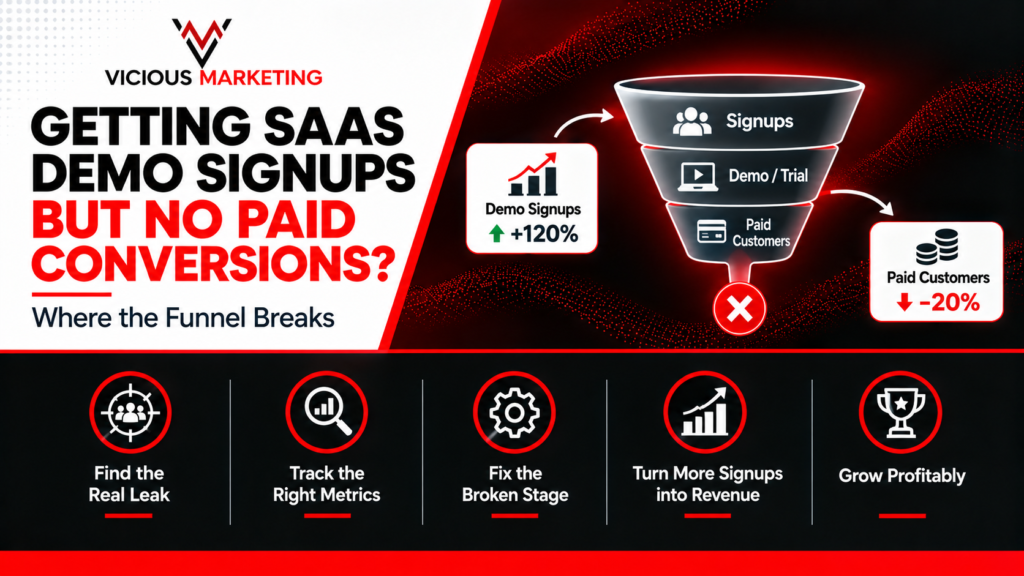
The signup chart looks healthy. The revenue chart doesn’t. Trials and demo bookings are up, paying customers aren’t.
This is almost never a traffic problem. More signups won’t fix it. The leak sits between signup and paid, and it’s usually one or two specific stages, not the whole funnel. It also costs more than it looks. Every signup that doesn’t convert is CAC you’ve already spent with nothing back, so a weak SaaS trial to paid conversion rate quietly inflates your true cost per customer.
This guide covers the five places a SaaS funnel breaks, how to tell which one is yours and how to fix the stage that’s actually failing. If you’d rather skip to the fix, our conversion optimization team does exactly this.
First, Define the Problem Properly
Two different funnels break in different ways, so name yours first.
Self-serve or product-led: signup, activation, usage, paywall, paid.
Sales-assisted or demo-led: demo booked, demo attended, follow-up, proposal, closed.
The core metric is your trial to paid conversion rate (or demo-to-close rate for the second funnel). Plainly put, it’s the share of people who start a trial or book a demo who end up paying. What counts as “good” varies by motion and price point, so compare against your own trend, not someone else’s number.
The trap is optimising the top. More signups and more booked demos are easy to measure, so teams chase them. Meanwhile the real leak sits lower down, where it’s harder to see. Here are the five stages, top to bottom.
The 5 Places Your SaaS Funnel Leaks
1. You’re Attracting the Wrong Signups
What it looks like: lots of signups, low intent and high churn in week one.
Why it happens: paid and content targeting get optimised for signup volume, not fit. The platform happily finds cheap signups who were never going to buy.
The metric that exposes it: trial-to-paid by source, and cost per paying customer, not cost per signup.
The fix: qualify earlier, re-target to your ideal customer profile and judge channels on paying customers. When demo signups aren’t converting, the first question is usually who’s signing up, not what happens after.
2. They Never Reach First Value
What it looks like: users sign up, poke around once and never come back.
Why it happens: onboarding doesn’t get them to the “aha” moment fast enough. Too many steps stand between signup and value.
The metric that exposes it: activation rate (the share who complete the key action) and time to first value.
The fix: shorten the path to first value, guide the setup and remove dead steps. Take a simple example. If 40% of trial users activate and 25% of those pay, your trial-to-paid rate is 10%. Lift activation to 60% with no change at the paywall and it becomes 15%. That’s the same product and the same price, with half again as many customers.
3. They See Value but Feel No Reason to Pay Now
What it looks like: active users who stay on the free plan or let the trial lapse.
Why it happens: the upgrade trigger is weak. The paywall doesn’t bite where value is felt, and nothing creates urgency.
The metric that exposes it: the share of activated users who hit a paywall or limit, and conversion at trial expiry.
The fix: align the paywall to the moment users feel the value, and give them a clear reason to act now. This is the stage behind most “free trial not converting to paid” complaints from teams whose onboarding is actually fine.
4. The Upgrade Itself Has Friction
What it looks like: users intend to buy but stall at the last step.
Why it happens: confusing pricing, too many plans, a clunky checkout, or in B2B, procurement, security review and approvals nobody mapped.
The metric that exposes it: paywall-view-to-purchase rate and checkout drop-off.
The fix: simplify pricing and checkout, and add a sales-assist path for larger deals. Our post on conversion leaks in paid traffic shows how small friction points add up.
5. No One Follows Up (The Demo-Led Killer)
What it looks like: demos get booked, some people no-show and the rest go quiet after the call.
Why it happens: slow or no follow-up, no nurture and a lead that goes cold.
The metric that exposes it: demo-attended rate, follow-up speed and demo-to-close rate.
The fix: follow up fast, run a sequenced nurture and re-engage no-shows. If you sell into the US, make sure that follow-up is compliant, and see our guide to TCPA-safe lead follow-up.
How to Find Which Stage Is Actually Breaking
You can’t fix what you can’t see, so instrument the whole path first. For self-serve, that’s signup, activation, usage, paywall and paid. For demo-led, it’s demo, attended, follow-up and closed.
Put a conversion rate and a drop-off number on every step. The single biggest drop is your priority. Everything else waits.
What most people miss is how often measurement hides the real leak. Watch for three traps:
- Trial-to-paid reported as one number, so you can’t see where in the trial it dies.
- Product analytics and billing don’t reconcile, so “conversions” never match revenue. Our analytics and data management work fixes this.
- Self-serve and sales-assisted mixed into one funnel, averaging away both.
One or two stages usually account for most of the loss. Fix those before touching anything else. Once you know the stage, the fix is specific and cheap. Guessing is what’s expensive.
Why “Just Get More Signups” Makes It Worse
When paid conversions are low, the instinct is to pour more into the top of the funnel. It feels logical.
But if the funnel leaks at activation or upgrade, more signups just means more wasted CAC and a lower trial-to-paid rate. The economics look worse, not better. The truth is, more traffic can’t fix a broken funnel, and more spend can’t fix a weak offer. Fix the leak, then scale. For more on this pattern, read our post on traffic with no conversions.
Test for Profit, Not Just a Higher Conversion Rate
Here’s a warning that separates useful conversion work from generic CRO. A change that lifts trial-to-paid can still lose money.
A looser trial might convert more users, who then churn within two months. A discount might win signups at a worse lifetime value. The conversion rate went up, and the business got worse.
So judge every test on revenue per visitor and on downstream retention and LTV:CAC, not the conversion rate in isolation. That’s how we run conversion rate optimization: profit-judged testing, not vanity wins.
How Vicious Marketing Finds and Fixes the Leak
We don’t start by selling you more ads or a redesign. We diagnose where the funnel actually breaks, fix that stage, then scale what the economics prove works. It’s the approach behind the Vicious Marketing Operating System and our SaaS performance marketing work.
You get the stage that’s costing you the most, a prioritised fix list and what fixing it is worth in paying customers.
Find Out Where Your Trial-to-Paid Funnel Is Leaking
If trials and demos are up but revenue isn’t, the teardown shows which stage is failing first.
Book Your Free Acquisition Teardown
Frequently Asked Questions
What’s a good SaaS trial-to-paid conversion rate?
It depends on your motion, and published benchmarks disagree sharply. First Page Sage data cited by Userpilot puts opt-in trials (no credit card) at about 18% and credit-card-required trials near 49%. ChartMogul’s 2026 report, as summarised by Mean CEO, shows 8.9% and 31.4%. For sales-assisted B2B SaaS, one roundup reports a median near 12%, with 6% at the bottom quartile and 18% at the top. Treat these as context. Your own trend over time matters more.
Why are my free trials not converting to paid?
Usually it’s one of five things: the wrong signups, no first value, no reason to pay now, friction at upgrade or no follow-up. Measure each stage to see which one is yours.
How do I know if it’s a targeting problem or a product problem?
Compare trial-to-paid by source. If one source converts well and others don’t, it’s likely targeting. If every source is weak and activation is low, the problem is usually onboarding or the product experience.
Should I use a free trial or a demo for my SaaS?
It depends on price and complexity. Simple, lower-priced products often suit a self-serve trial. Complex, higher-priced products usually need a demo and sales conversation. Many teams combine both.