How to Fix TCPA-Safe Lead Follow-Up and Convert More US Leads

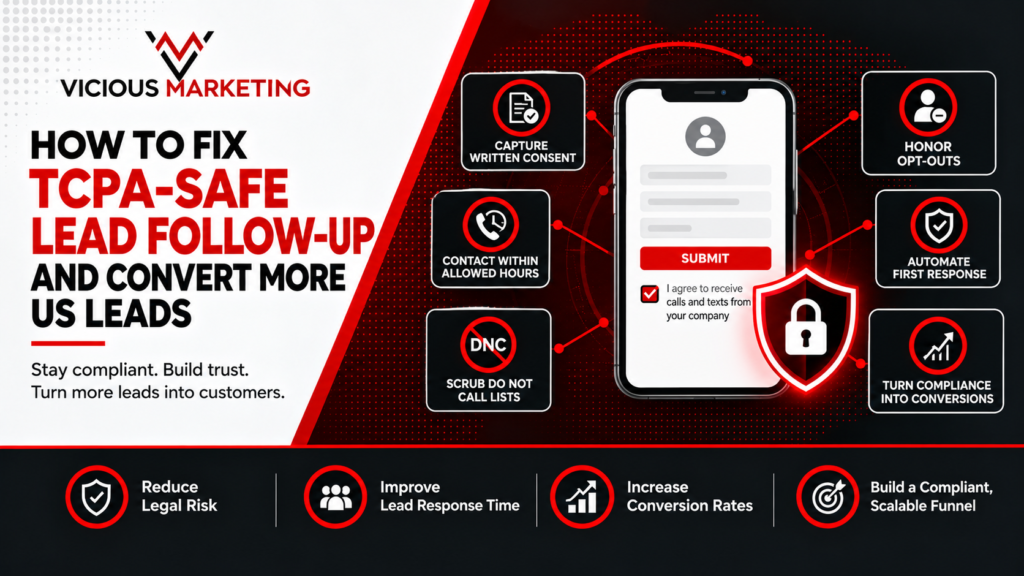
TCPA compliance and fast follow-up don’t conflict. Capture clear written consent at the form, check it before every call or text, contact only within allowed hours, scrub against Do Not Call lists and honor opt-outs everywhere within days. Then automate the first response. Compliance becomes the system that lets you move fast.
The lead filled out your form, and you waited. Speed decides conversion, but “just text everyone instantly” is how companies end up in TCPA class actions. Here’s the thing: the real fix is upstream. TCPA lead follow-up is a conversion problem (form, consent capture, routing, cadence) before it’s a legal one.
Below is a seven-step fix, a response cadence, an 8-question self-audit and a pre-send checklist. Opt-out rules are also in flux right now, so I’ve covered what changed. If you want help fixing the funnel itself, our conversion optimization services team does this work. This is general information, not legal advice.
| Your situation | Start at | Why |
| Leads come in but follow-up takes hours | Step 3 | Speed is your biggest leak |
| We buy or receive leads from vendors | Step 1 | You need proof of consent |
| We text leads but can’t prove consent | Steps 1 and 2 | Consent records come first |
| Opt-outs live in separate tools | Step 5 | Suppression has to sync |
Have only 30 minutes? Take the 8-question self-audit near the end.
What Is TCPA-Safe Lead Follow-Up?
TCPA-safe lead follow-up is the process of contacting inbound leads quickly, by call, text or email, in a way that follows the Telephone Consumer Protection Act: documented consent, allowed contact hours, Do Not Call checks and opt-outs that are honored. It covers the form, routing, cadence and opt-out handling, not just what the rep says.
| Riskier | Safer | |
| Consent | Phone number collected, no record of what the lead agreed to | Separate consent box, disclosure and proof stored per lead |
| Timing | Blast texts at any hour | Contact within allowed hours for the lead’s time zone |
| Opt-out | “STOP” handled in one tool only | Suppression synced across CRM, dialer, SMS and vendors |
No process removes risk entirely. This reduces it.
Why It Matters
Speed wins leads, but speed without consent creates liability. The fastest channels, calls and texts, are exactly the ones the TCPA regulates.
The cost of getting it wrong is high. TCPA claims are commonly brought as class actions, with statutory damages commonly cited at $500 per violation and up to $1,500 if willful. Those can multiply per call or text, so small mistakes scale fast.
It’s also a conversion issue. Messy consent capture means you can’t use leads you already paid for, and unhandled opt-outs lead to complaints and blocked numbers. The form, routing and suppression fixes are really conversion rate optimization fixes.
What Changed in 2025 to 2027 (as of November 2026)
- One-to-one consent: the Eleventh Circuit vacated the FCC’s one-to-one consent rule on January 24, 2025, just before it was set to take effect. Lead generators and buyers continue under the existing consent framework.
- “Revoke-all”: in January 2026 the FCC delayed the revoke-all rule from April 11, 2026 to January 31, 2027. But there’s a newer development. According to one law firm’s analysis, on October 1, 2026 the FCC released an order replacing the revoke-all requirement with category-specific opt-out rules, taking effect 30 days after Federal Register publication, which makes the January 31, 2027 date moot.
- Other revocation rules: the existing obligation to honor revocation requests within 10 business days remains in place.
The truth is, this area moves fast. Check the current status before you act on any date.
Step 1: Audit Consent at Every Source
Check forms, landing pages, call-center scripts and lead vendors. Prior express written consent is generally required for autodialed or prerecorded marketing calls and texts. Store proof per lead: timestamp, page version, disclosure text and IP. For purchased or partner leads, ask for the consent record, not just a “compliant” claim. Our performance-based lead generation guide and regulated market acquisition playbook go deeper.
Do this week: pull ten recent leads and try to find their consent proof.
Check: every source, including vendors.
Metric: share of leads with complete consent records.
Step 2: Rebuild the Form So Consent and Conversion Both Improve
Use a separate, unchecked consent box with one clear disclosure, not bundled with terms. Explain why you need the phone number. Then test label wording, placement and field order against completion rate. This is where conversion optimization and compliance meet. See our post on conversion leaks in paid traffic.
Do this week: launch one consent-wording test.
Check: consent capture on mobile.
Metric: form completion rate and consent rate.
Step 3: Respond Fast on Channels You Have Consent For
Set a response-time SLA in minutes, not hours. Auto-confirm by email at second zero, and route by time zone and availability. Email falls under different rules (CAN-SPAM) than calls and texts, and you should have counsel confirm which of your dialing and texting tools count as automated.
What most people miss is how slow the market is. A widely cited Harvard Business Review audit of 2,241 US companies put the average B2B lead response at 42 hours. Our post on traffic with no conversions shows what that delay costs.
Do this week: measure your real time to first contact.
Check: routing by time zone.
Metric: speed to first contact.
Step 4: Use a Compliant Follow-Up Cadence
| Touch | Timing | Channel | Compliance gate |
| Confirmation | Instant | Lead-provided address | |
| First attempt | Within minutes | Call | Consent on file, allowed hours |
| Follow-up | Same day | Opt-out link | |
| Second attempt | Next day | Call or text | Frequency cap, consent |
| Capped sequence | Days 3 to 10 | Mixed | Stop condition, suppression check |
Contact hours are generally 8am to 9pm in the recipient’s local time, and some states are stricter. Automate this with customer journey automation.
Do this week: write the cadence down, with stop conditions.
Metric: contact rate.
Step 5: Make Opt-Outs Instant and Universal
Accept “STOP,” “quit,” “cancel” and plain-language requests. Sync suppression across CRM, dialer, SMS tool, email platform and vendors. Treat 10 business days as a legal ceiling, not a target. And since the rule is shifting toward category-specific opt-outs, confirm your platforms can support category-level handling. Our analytics and data management service helps connect these systems.
Do this week: test an opt-out in one tool and see where it shows up.
Metric: time from opt-out to suppression everywhere.
Step 6: Scrub Before You Dial or Text
Check the National Do Not Call Registry, state lists, your internal list and a reassigned-numbers database. Some state “mini-TCPA” laws can be stricter. Florida and Oklahoma are commonly cited examples.
Do this week: document your scrub process and frequency.
Metric: scrub coverage and complaint rate.
Step 7: Measure the System, Not Just Speed
Track speed to first contact, contact rate, lead-to-opportunity rate, opt-out rate, complaint rate and consent-record completeness. Compare conversion by consent-flow variant. You can learn about full-funnel strategies for fintech brands to tie it together.
Do this week: build one dashboard with those six numbers.
The 8-Question Self-Audit
- Do we store proof of consent for every lead?
- Is the consent box separate and unchecked by default?
- Do we check consent before every call or text?
- Do we know which of our tools count as automated dialing or texting?
- Do we contact leads only in allowed hours for their time zone?
- Do we scrub against federal, state and internal DNC lists?
- Does an opt-out in one tool stop messages in every tool?
- Can we show our response time and opt-out rate this week?
Scoring: 0 to 4 yes, start at steps 1 and 5. 5 to 7 yes, tune steps 3 and 7. 8 yes, test your form copy.
Common Mistakes
- Buying leads without consent proof
- Assuming a vendor’s “compliant” label covers you
- Reusing old leads
- Ignoring informal opt-out wording
- Texting outside allowed hours
Find the Leak
Most follow-up problems sit in the form and routing, not the sales script, so conversion optimization and compliance fixes are usually the same project. We audit your lead capture, routing and follow-up flow and rank the fixes by impact. Book your free acquisition teardown now.
Frequently Asked Questions
What does TCPA-safe lead follow-up mean?
It’s about contacting inbound leads quickly while following the TCPA: documented consent, allowed hours, Do Not Call checks and honored opt-outs. Ask counsel about your specific setup.
Does the TCPA apply to leads who fill out my web form?
Yes, if you contact them by autodialed or prerecorded calls or texts. Consent captured at the form is what you’ll rely on, so records matter. Ask counsel about your specific setup.
How fast do I need to respond to a lead?
The TCPA sets no response deadline. Speed is a conversion issue, so aim for minutes, on channels you have consent for. Ask counsel about your specific setup.
Can I text a lead who gave me their number?
Only if they gave the right kind of consent for texts. A phone number alone usually isn’t enough. Ask counsel about your specific setup.
What are the penalties for TCPA violations?
Statutory damages are commonly cited at $500 per violation, up to $1,500 if willful, and class actions can multiply that. Ask counsel about your specific setup.