10 Ways to Lower Customer Acquisition Cost in the USA in 2027

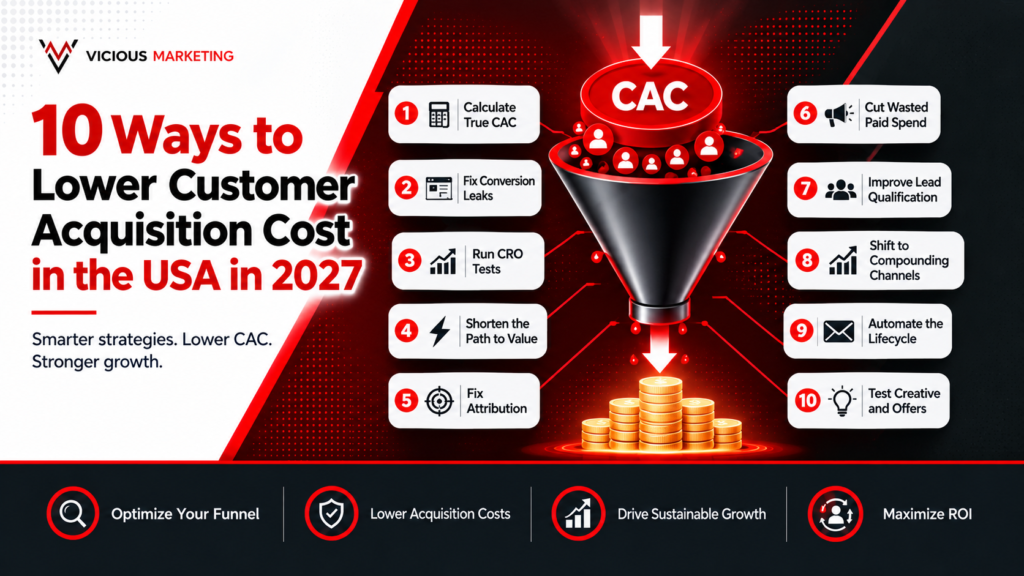
To lower customer acquisition cost, it is important to increase the amount of visitors who become customers. Then cut wasted spend, then shift your channel mix. Measure true CAC first. Conversion fixes usually pay back fastest, while channel and SEO changes take longer. This list is ranked by effort and speed.
CAC keeps climbing, and cutting ad spend usually shrinks growth instead of fixing the cost. CAC is spent divided by customers, so the fastest lever is usually the denominator, which is conversion. Below are ten ways to reduce CAC, each with a US watch-out, since Q4 ad-cost spikes and state privacy rules that affect tracking add real pressure. Pick one this week, or get help from our conversion optimization services.
| Way | Effort | Time to impact | Do this first if… |
| 1. Calculate true CAC | Low | Days | You’ve never loaded costs |
| 2. Fix landing page leaks | Low to medium | Weeks | Traffic is fine, customers are few |
| 3. Run a CRO testing program | Medium | 1 to 3 months | You have enough traffic to test |
| 4. Shorten the path to first value | Medium | Weeks | Signup or checkout drop-off is high |
| 5. Fix attribution | Medium | 1 to 2 months | You can’t tell which channels work |
| 6. Cut wasted paid spend | Low | Weeks | Conversion is fine, CAC is high |
| 7. Improve lead qualification | Low to medium | Weeks | Leads go cold |
| 8. Shift to compounding channels | High | 6+ months | Paid costs keep rising |
| 9. Automate the lifecycle | Medium | 1 to 3 months | Payback is slow |
| 10. Test creative and offers | Medium | Weeks | Ads or offers feel stale |
Only 30 minutes? Do #1 and #2. If traffic is fine but customers are few, start at #2 to 4. If conversion is fine but CAC is high, start at #5 and 6.
1. Calculate True, Fully Loaded CAC by Channel
Include tools, salaries and agency fees, not just ad spend. Here’s an illustrative example: $50,000 spend ÷ 250 customers = $200 CAC. Add $15,000 of loaded costs and it’s really $260. See the hidden costs of CAC for more.
Do this week: pull last quarter’s costs by channel.
Measure: fully loaded CAC per channel.
Watch out (US): Q4 spikes distort quarterly averages, so compare like quarters.
2. Fix Conversion Leaks on Paid Landing Pages
Check message match, load speed, form length and mobile experience. Using the same example, a lift from 2% to 2.5% conversion at the same traffic cuts that $200 CAC to $160. Our posts on conversion leaks in paid traffic and traffic with no conversions go deeper.
Do this week: compare your top landing page to its ad copy.
Measure: landing page conversion rate.
Watch out (US): consent banners under state privacy rules can slow pages or block forms, so test their impact.
3. Run a Prioritised CRO Testing Program
Score ideas with ICE or PIE, run one hypothesis per page and use a realistic sample size. The truth is, low-traffic sites often run tests that can never reach significance. Our conversion rate optimization services can help you set this up.
Do this week: score ten test ideas.
Measure: win rate and incremental lift.
Watch out (US): holiday-only data skews results, so don’t call tests on Q4 traffic alone.
4. Shorten the Path to First Value
Simplify signup, checkout or demo booking, and design mobile-first. [Insert sourced US mobile traffic share.]
Do this week: remove one field or step.
Measure: completion rate and time to first value.
Watch out (US): fintech and regulated flows need required steps like identity verification, so cut friction around them, not through them.
5. Fix Attribution Before Moving Budget
Bad attribution makes you cut the wrong channels. Privacy-compliant, first-party tracking gives you a more reliable base.
Do this week: compare platform-reported and CRM-reported conversions.
Measure: share of conversions with a known source.
Watch out (US): opt-outs under state privacy laws erode cookie-based tracking.
6. Cut Wasted Paid Spend
Add negatives, audience and geo exclusions, and reallocate by marginal CAC rather than average CAC. What most people miss is that a campaign’s average can look fine while its next dollar performs badly.
Do this week: review search terms and exclude states you can’t serve.
Measure: marginal CAC by campaign.
Watch out (US): Q4 bids inflate costs, so judge campaigns against like periods.
7. Improve Lead Qualification and Speed-to-Lead
Tighten the sales handoff and shorten response time. Leads go cold fast.
Do this week: set a response-time target and clear handoff criteria.
Measure: lead-to-opportunity rate and response time.
Watch out (US): TCPA and consent rules apply to calls and texts, so confirm documented consent first.
8. Shift Mix Toward Compounding Channels
SEO and AI-search visibility lower blended CAC over time, but they take months. Say that plainly to your team.
Do this week: pick five high-intent topics to build pages around.
Measure: blended CAC and organic-sourced customers.
Watch out (US): don’t cut paid before organic ramps up, or you’ll create a gap.
9. Shorten CAC Payback With Lifecycle Automation
To be honest, this improves payback and CAC:LTV rather than raw CAC. Still worth it. See customer journey automation.
Do this week: automate one onboarding email sequence.
Measure: CAC payback period and CAC:LTV.
Watch out (US): follow CAN-SPAM unsubscribe rules and state privacy requirements.
10. Test Creative and Offers Systematically
Run structured tests within US ad rules. Learn well about automated policy audits and paid search for regulated markets.
Do this week: test one new angle per ad set.
Measure: click-to-customer rate and cost per customer.
Watch out (US): FTC claim substantiation and platform policies apply, with extra care in regulated verticals.
Which One First?
Use the rule from the table: weak conversion means start at #2 to 4, high CAC with decent conversion means start at #5 and 6. CAC reflects the whole funnel, so one number won’t show where it’s leaking.
Our free acquisition teardown shows where acquisition cost is leaking, ranked by impact. Get your free acquisition teardown or talk to our conversion optimization team. For proof, see how we reduced customer acquisition cost.
Frequently Asked Questions
What is a good customer acquisition cost in the USA?
There’s no national average. Common benchmarks are an LTV to CAC ratio near 3:1 and payback within about 12 months, though both vary by industry.
How do you calculate customer acquisition cost?
Customer acquisition cost is calculated by dividing your total acquisition expenses by the number of new customers acquired during the same period.
CAC = Total Customer Acquisition Costs ÷ Number of New Customers
How long does it take to lower CAC?
Conversion fixes can show results in weeks. Channel and SEO shifts take months.
What’s the difference between CAC and ROAS?
CAC measures cost per customer, while ROAS measures revenue per ad dollar. See ROAS vs CAC.
Should I cut ad spend to lower CAC?
Not necessarily. Cutting advertising budgets may reduce total spending, but it can also reduce customer acquisition and slow business growth. A high CAC does not always mean you are spending too much; it may indicate that your campaigns, landing pages or conversion funnel are not performing efficiently.
Before reducing your budget, review campaign-level performance, search terms, audience quality, geographic targeting and conversion rates. Identify campaigns with high marginal CAC and redirect spending toward channels and campaigns that acquire customers more efficiently.