8 Sports Betting SEO Mistakes Quietly Costing You Organic Signups

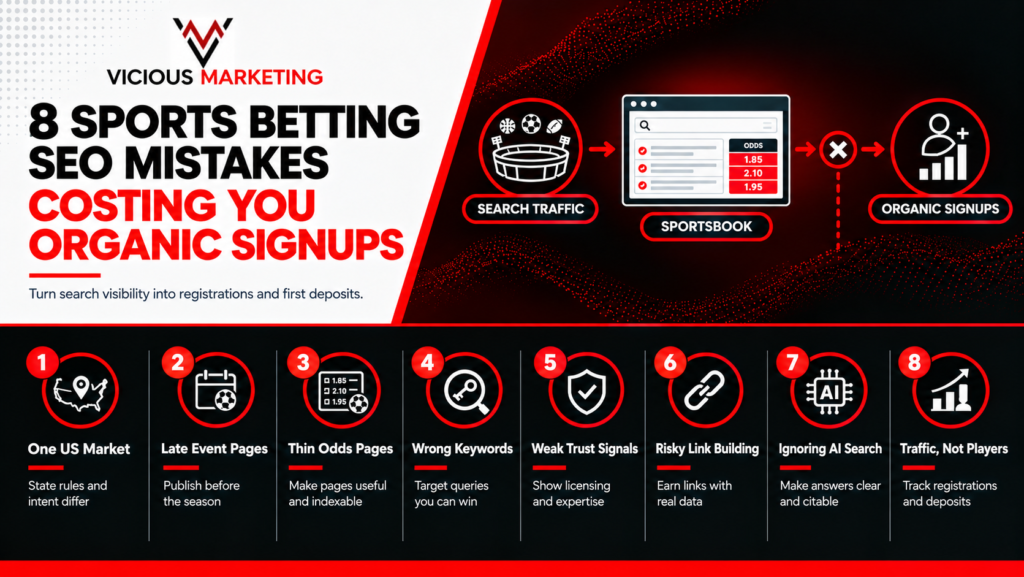
Your sportsbook gets a traffic spike every time a season kicks off. Then it fades, and the signups never match the sessions.
Sports betting SEO isn’t one tactic. It’s a stack of decisions about states, seasons, odds data, trust and links, and one weak layer caps everything above it. Below are the eight mistakes behind that gap, the insight that explains each, and the fix. Our iGaming SEO strategy 2026 post covers the big picture. This one names specific problems you can fix this quarter, the kind of work our iGaming SEO services are built around.
How Sports Betting Search Actually Works
Before learning about mistakes, you need a mental model. Betting searches split into four layers, and each has a different SERP, a different owner and a different content type.
| Layer | Example query | Who usually ranks | Right page type |
| Learn | how do parlays work | Publishers, educational sites | How-to and bet-type guides |
| Event | NFL odds this week | Odds sites, operators | Evergreen sport and event hubs |
| Local-legal | sports betting in Ohio | State-focused publishers, operators | State hub pages |
| Brand-bonus | [operator] promo | The operators, affiliates | Brand and promo pages |
Most sites are built for only one layer. And demand is seasonal and event-driven, so when you publish matters as much as what you publish.
1. Treating the US as One Market
One generic “US” page set makes you invisible for “sports betting in [state],” where intent is highest. It hides well, because total traffic looks healthy and nobody checks state-level visibility. This is the classic sports betting SEO mistake.
The truth is, regulation is state by state, so the SERP is too. Each state has its own launch status, rules, licensed operators and local teams, and searchers type the state name. Build one hub per licensed state with launch status, legal age, available markets, local teams and a compliance footer. Make each one genuinely different so they don’t read as templates. And handle geo-restrictions without showing search engines different content than users see, because that’s a cloaking risk.
2. Building Event Pages Too Late, on Throwaway URLs
Picture the “Super Bowl odds” page published a week before the game. It gets a few clicks, so it feels like a win. The real cost is that it never had time to rank, and it restarts from zero every year.
Pages need weeks to be crawled, indexed and linked to. The sites that win event queries usually held the URL all year and refreshed it. So use evergreen URLs like /nfl/betting/ instead of new yearly pages, and publish ahead of the season. Build your 2026-27 calendar now:
| Event | Refresh by |
| NFL season and playoffs | Before kickoff |
| Super Bowl (Feb 2027) | Early January |
| March Madness 2027 | Late February |
| NBA and NHL playoff runs | Before the regular season ends |
3. Thin, Duplicate or JavaScript-Heavy Odds Pages
You have thousands of odds and fixture pages, but only a fraction rank. Page count rises, so the CMS looks healthy. Indexing is the number that’s flat.
Google can crawl a page and still choose not to index it. “Crawled, currently not indexed” in Search Console is often where near-duplicate odds pages end up, along with pages whose content only appears after JavaScript runs. Expired fixtures add noise too. Audit indexed versus published pages, add unique context to each template (form, head-to-head, injuries, bet types), and put key content in rendered HTML. Consolidate or no-index pages with no search value, since wasted crawl on low-value URLs slows the pages that matter. Our post on the crawl budget for large sites explains how.
4. Fighting Affiliates on the Wrong Keywords
“Best sportsbook” looks like the prize. The volume is huge, so the effort feels justified even when the page never leaves page two.
What most people miss is that those SERPs are built for comparison, and established affiliate publishers own that format and the trust that goes with it. An operator’s real advantage is first-party knowledge: your own odds, markets and product. So go where you have the edge: bet-type guides (parlays, moneyline, spreads, props), odds explainers, sport and league hubs, and brand plus sport queries. Keep comparison content only where you can compete credibly. There’s more in our companion read on common iGaming SEO mistakes.
5. Weak Trust Signals on a High-Stakes Topic
Anonymous authors, thin licensing info and a responsible-gambling page that feels like an afterthought. Nothing breaks and no penalty appears. Pages just stall below where they should rank.
Gambling involves money and potential harm, so trust matters more here than on most topics. Search engines and users both look for who is behind the content and whether the operator is legitimate. Add named, credentialed authors with short bios, clear licensing and regulator details, visible responsible-gambling resources and age warnings, an editorial and fact-checking policy, and sources on your claims.
6. A Link Profile Built for Yesterday’s Rules
Paid placements and private blog networks still “work,” until they don’t. The gains come quickly, so the risk only shows when an update lands.
Google has tightened its spam policies, including around site reputation abuse and third-party content hosted on reputable sites, and gambling is among the most exposed categories. Links you can’t defend are a liability you carry quietly. Shift toward data-led digital PR, original betting and sports research journalists want to cite, expert commentary and real partnerships, and audit existing backlinks for risky patterns. Start with our iGaming link building guide and see how the August 2025 spam update changed the picture.
7. Ignoring How AI Search Answers Betting Questions
“How do parlays work” and “what does -110 mean” now get answered before anyone clicks. Rankings hold steady while clicks fall, and rank trackers don’t show you why.
AI Overviews and chat assistants favor clear, quotable, well-sourced answers. Educational betting content is exactly what they pull from, so it’s both a risk to your clicks and a chance to be cited. Lead with a direct definition, add short answer blocks, worked examples and FAQ schema, and track visibility in AI answers alongside rankings. Keep brand and licensing information consistent across the web. Our take on sportsbook SEO vs GEO covers why you need both.
8. Measuring Traffic Instead of Players
This is the bonus mistake, the one that hides all the others. Sessions and rankings are easy to report. Registrations and first deposits take effort to connect back to organic.
A spike of seasonal, low-intent traffic can look like growth while adding nothing to deposits. The useful questions are which states, sports and intents produce registrations, and what organic players are worth over time. Report organic by landing page, state and intent layer, all the way through to the first deposit, and compare seasonal peaks year over year, not month over month. Read the case study which shows what tying SEO to acquisition cost looks like in practice.
A 90-Day Plan for the 2026-27 Season
Now what can you do to avoid these sports betting SEO mistakes that we have discussed above? You can make this 90-day plan using Monday.com to execute a better sports betting SEO strategy.
- Days 1-30, foundations: audit indexed versus published pages, fix trust pages, and map your state coverage against the four intent layers.
- Days 31-60, build: launch or upgrade state hubs and evergreen sport hubs, rebuild odds templates with unique context, and publish how-to-bet guides. In this phase, it is important to pivot according to state sports betting pages.
- Days 61-90, earn and measure: start data-led digital PR, add FAQ schema, and connect organic to registration and first deposit by state.
Where to Start
One thing you need to understand about sports betting SEO is that most sportsbooks carry three or four of these at once, and a single traffic number hides it. If you’d like a second opinion on which ones apply to you, our iGaming SEO services page explains how we approach it.
Frequently Asked Questions
What is sports betting SEO?
It’s improving a sportsbook’s organic visibility through state pages, sport and event hubs, technical performance for odds data, trust signals and link building.
How long does sports betting SEO take to work?
Expect early movement in a few months and meaningful growth in six to twelve, depending on domain strength, competition and technical cleanup. Seasonal pages should go live well before the event.
Can a sportsbook rank for “best sportsbook” keywords?
It’s difficult, since affiliate publishers dominate those results. Most operators do better starting with how-to-bet content, sport hubs and state pages.
How should you handle seasonal sports events in SEO?
Use evergreen URLs, refresh them each season, publish early and plan the yearly calendar in advance.
Is SEO worth it when gambling ads are restricted?
Yes. With paid options limited on several platforms, organic search is one of the few scalable channels.