6 Conversion Leaks Quietly Draining Your Paid Traffic

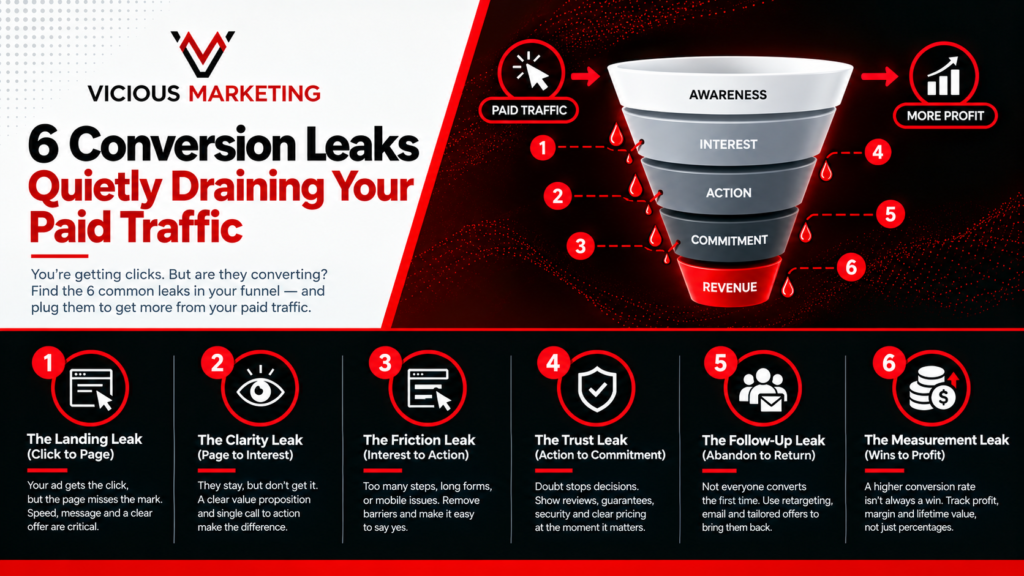
Conversion leaks are why every paid click you buy fails to turn into revenue. Most funnels leak at predictable points. Here’s the thing: you probably don’t have a traffic problem. You have a retention-through-the-funnel problem, and raising ad spend just pours more water into the same holes.
This guide maps the six leaks stage by stage, from the first click to the final measurement, and shows what plugging each one recovers. It’s also how our approach to conversion rate optimization works: find which leaks are costing the most, then fix them in priority order.
1. The Landing Leak (Click to Page)
This is the first handoff, and it’s where your most expensive clicks go to die. The ad promised one thing. The page delivers something vaguer, loads slowly or opens with a weak, cluttered top section. Visitors decide in a heartbeat, and a mismatch feels like a wrong turn.
What leaks out: your priciest clicks, almost instantly.
The fix: match the message and speed up the page. Mirror the ad’s headline and offer above the fold, compress heavy images and test on a real phone over a normal connection, not office wifi.
2. The Clarity Leak (Page to Interest)
The visitor stays, but nothing clicks. They scroll, squint and still can’t tell what you offer, who it’s for or what to do next. What most people miss is that confusion looks a lot like disinterest in your analytics.
What leaks out: undecided buyers who might have said yes with a little direction.
The fix: one clear value proposition and one primary call to action. Say what you do in plain language, show the next step once and make it obvious. Everything else on the page should support that single move.
3. The Friction Leak (Interest to Action)
Now the visitor wants to act, and you make it hard. Long forms. Forced account creation. Extra steps. A checkout that misbehaves on mobile. Each obstacle is small. Together they’re a wall.
What leaks out: ready buyers at the final click, the most painful loss of all.
The fix: remove steps and cut fields. Ask only for what you truly need now and collect the rest later. Offer guest checkout where it makes sense and fix mobile issues first, since that’s where many paid visitors arrive. Funnel reports and session recordings will show you exactly where people give up.
4. The Trust Leak (Action to Commitment)
Right before someone hands over money, details or a commitment, doubt kicks in. If there’s no proof where that decision happens, hesitation wins. Trust built on the homepage doesn’t always travel to the checkout.
What leaks out: hesitant but high-intent visitors, people who were nearly there.
The fix: put proof at the decision point. Reviews, guarantees, security badges, clear pricing and compliance cues belong beside the button or form, not buried two pages back. Make contact details easy to find too, because reassurance often matters more than persuasion at this stage.
5. The Follow-Up Leak (Abandon to Return)
Not everyone converts on the first visit, and that’s normal. The leak appears when there’s no plan for the ones who bounce. You’ve already paid to acquire them, and then you let them vanish.
What leaks out: recoverable conversions you already paid for.
The fix: segmented retargeting and recovery flows. Someone who abandoned a cart needs a different message from someone who read one article and left. Use email or SMS reminders, tailored ads and simple win-back offers where appropriate, always respecting consent rules. For how this connects to the rest of your marketing, see our guide to full-funnel marketing.
6. The Measurement Leak (Wins to Profit)
This one hides in plain sight. You run tests, celebrate a lifted conversion rate and move on. But if the winning variant attracted lower-value customers, gave away too much margin or reduced order size, you’ve made things worse while feeling successful.
What leaks out: margin. The truth is, a better rate can still mean a worse profit and loss statement.
The fix: judge A/B tests on profit-based metrics like revenue per visitor, margin and lifetime value, not conversion rate alone. Decide in advance what counts as a real win, run tests long enough to trust the result and track downstream outcomes such as refunds or churn. Solid conversion rate optimization always ties testing back to money, not just percentages.
Find Which Leak Is Costing You Most
You don’t need to fix all six at once. You need to know which one is draining the most money first. Fixing a small leak while a big one runs unchecked is how teams stay busy and see no change.
Our Acquisition Teardown maps the leaks across your funnel and prices the fix, so your effort goes where it pays back fastest. Explore our conversion optimization services to see how it works.
Frequently Asked Questions
What is a conversion leak?
It is a point in your funnel where potential customers leave the page before completing the action you want like buying or signing up. Generally, leaks come from messaging, page design, friction, missing trust signals, weak follow-up or poor measurement.
How do I find where my funnel is losing conversions?
Start by mapping each stage and measuring drop-off between them. Funnel reports, session recordings, heatmaps and simple user tests usually reveal the biggest gaps. Look first at the stages with the largest volume of lost visitors, since small improvements there tend to have the biggest effect.
Is conversion rate optimization worth it for paid traffic?
Often, yes, because you’re already paying for every visit. Improving how many of those visitors convert can lower your cost per acquisition without needing more traffic. The size of the return depends on your volume, margins and how many leaks currently exist.
Conversion rate optimization vs more ad spend: which first?
In most cases, fix the funnel before scaling spend. More budget on a leaky funnel multiplies waste, while a healthier funnel makes every extra pound or dollar work harder. Once the biggest leaks are plugged, scaling becomes far more efficient.