7 Reasons You’re Getting Traffic but No Conversions

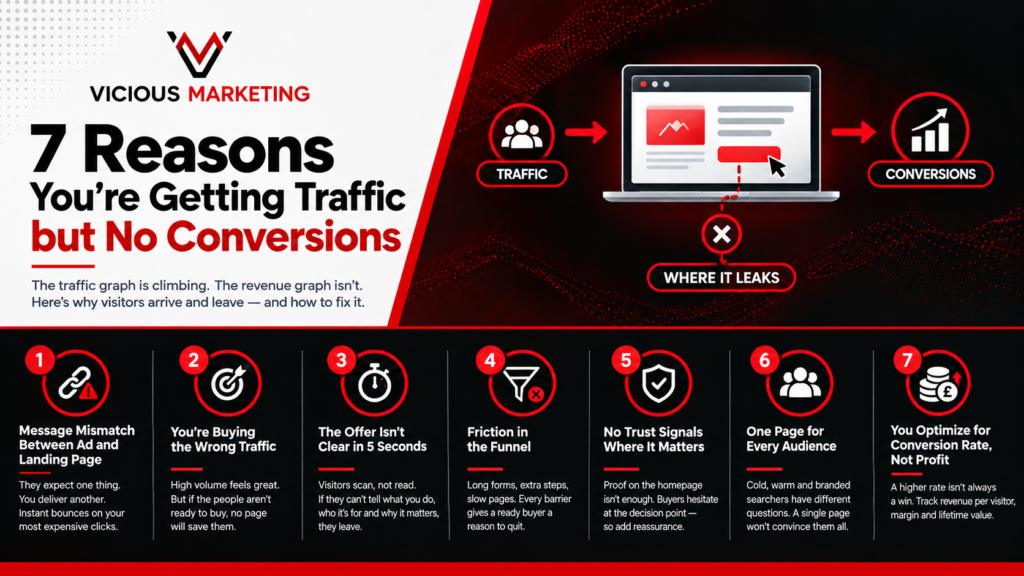
The traffic graph is climbing. The revenue graph isn’t. You’re paying for clicks that never pay back, and every week the gap gets a little more expensive. Here’s the thing: more traffic won’t fix traffic but no conversions. The leak sits somewhere between the click and the conversion, and pouring more budget in just makes it bigger.
Below are the seven reasons visitors arrive and leave, ranked by how much they tend to cost you, plus what fixing each one looks like. It’s the same diagnosis we run through our conversion optimization services before anyone touches spend.
1. Message Mismatch Between Ad and Landing Page
Someone clicks an ad promising one thing and lands on a page that talks about something else. Maybe the offer is missing, the headline is generic or the wording doesn’t match. That tiny moment of “wait, is this the right page?” is often all it takes.
What it costs you: instant bounces on your most expensive clicks.
The fix: match the message from ad to page. Mirror the headline, the offer and the promise that earned the click, so the visitor feels they’ve landed exactly where they meant to.
2. You’re Buying the Wrong Traffic
High volume feels great in a report. But if the people arriving were never likely to buy, no landing page will rescue them. What most people miss is that cheap clicks and good clicks are rarely the same thing. This is the most common culprit for high traffic but no conversions.
What it costs you: spend scales, conversions stay flat.
The fix: target by intent, not just reach. Tighten keywords, audiences and placements around people actually close to a decision. Our guide to full-funnel marketing shows how to match traffic to each stage of the buying journey.
3. The Offer Isn’t Clear in 5 Seconds
Visitors don’t read, they scan. If they can’t tell what you do, who it’s for and why they should care within a few seconds, they leave. Clever copy rarely beats clear copy.
What it costs you: drop-off before they even scroll.
The fix: one clear value proposition and one primary call to action, placed where the eye lands first. Cut anything that competes with them. A good test is to show the page to someone unfamiliar with your business for five seconds, then ask what you sell and who it’s for. If they can’t answer, your visitors can’t either.
4. Friction in the Funnel
Long forms. Forced account creation. Slow mobile pages. Extra steps nobody asked for. Every one of these gives a ready buyer a reason to quit, often at the very last click.
What it costs you: abandoned conversions from people who actually wanted to buy.
The fix: remove steps, trim form fields, allow guest checkout where it makes sense and cut load time, especially on mobile. Then watch where people drop off rather than guessing. Session recordings, funnel reports and a few honest test purchases on your own phone will usually show you the problem faster than any debate in a meeting.
5. No Trust Signals Where the Decision Happens
Proof on the homepage doesn’t help much if the pricing page, form or checkout has none. People hesitate at the moment of commitment, and that’s exactly where reassurance matters most.
What it costs you: ready buyers pause, doubt and leave.
The fix: put proof at the decision point. That means reviews, guarantees, security and compliance cues, and clear contact details right beside the button, not three scrolls away.
6. One Page for Every Audience
Cold traffic, warm retargeting and branded searchers all arrive with different questions. Sending them to the same page means none of their objections get properly answered.
What it costs you: a page that speaks to everyone and convinces no one.
The fix: build segment-matched pages. A cold visitor needs context and credibility. A returning one needs a nudge and a clear next step. A branded searcher wants to get on with it. You don’t need dozens of variants on day one. Start with your highest-spend segment, test one tailored page against the generic one and let the results tell you where else it’s worth the effort.
7. You Optimize for Conversion Rate, Not Profit
The truth is, a “winning” test can still hurt you. Lift signups with a cheaper, more generous offer and your rate improves while revenue per visitor falls. You’ve got a better percentage and a worse P&L.
What it costs you: celebrating wins that quietly shrink your margins.
The fix: judge tests on profit, not just rate. Track revenue per visitor, margin and lifetime value alongside conversions. For a deeper look at tying spend to returns, see our guide to turning PPC into profit. If you want help setting that up, our conversion optimization services are built around exactly this approach.
Stop Paying for Traffic That Leaks
Most sites are leaking at three or four of these points at once and can’t see which one is costing the most. That’s why we start with an Acquisition Teardown. It finds the leaks, ranks them and prices the fix, so you know where your next pound or dollar should go. Explore our conversion optimization services to see how it works.
Frequently Asked Questions
Why am I experiencing high traffic but no conversions?
The simple reason for high traffic but no conversions or low conversion is usually because the visitors, the message or the page experience are not aligned. Common culprits are low-intent traffic, an unclear offer, ad-to-page mismatch, friction in forms or checkout and missing trust signals.
Is it a traffic problem or a landing page problem?
Look at where people drop off. If visitors bounce straight away, the traffic or the message match is likely off. If they engage but don’t act, the offer, friction or trust signals are the more likely cause. Often it’s a mix.
What’s a good conversion rate for paid traffic?
It varies widely by industry, offer, price point and traffic source, so there’s no single number worth chasing. A better benchmark is your own baseline, and whether each change improves revenue per visitor.
How fast can CRO recover wasted ad spend?
It depends on your traffic volume and how many leaks there are. Fixing obvious problems like message mismatch and friction can show movement quickly, while larger tests take longer to reach reliable results.