CRO Agency vs In-House: Which Lowers Cost per Acquisition Faster?

Your conversion rate is costing you money, and you’re choosing between building a CRO function in-house or hiring an agency.
Most comparisons argue about cost and control. Those matter, but they aren’t the deciding factor. Here’s the thing: the question that matters is which option lowers your cost per acquisition fastest, because every month spent deciding is a month of wasted spend.
It’s also harder than it looks, because CRO isn’t one skill. It’s five: analytics, design, copy, development and experimentation. Cover four, and the fifth quietly becomes your bottleneck.
So here’s an honest CRO agency vs in-house comparison across the criteria that decide speed and cost, when each option genuinely wins and how to choose. Full disclosure: we’re an agency, so we’ll flag the cases where in-house is the better call. If you want to see how we approach conversion optimization, our services page covers it.
What “In-House CRO” and “CRO Agency” Actually Mean
In-house means hiring or assigning people to own testing and optimisation. That might be a CRO manager, plus or minus a designer, analyst and developer.
An agency is an outside team that brings the full skill set, tooling and process on day one, and works to a retainer or a performance arrangement.
The hidden truth is that a single “CRO manager” hire isn’t a CRO function. Real CRO needs analytics to find the leak, design and copy to build the variant, development to ship it and discipline to test it properly. A complete in-house team typically means a CRO manager, a data analyst, a designer, a developer and potentially a user researcher. In-house often ends up as one person trying to cover all five.
So the comparison isn’t person versus agency. It’s one role versus a full function.
The Side-by-Side
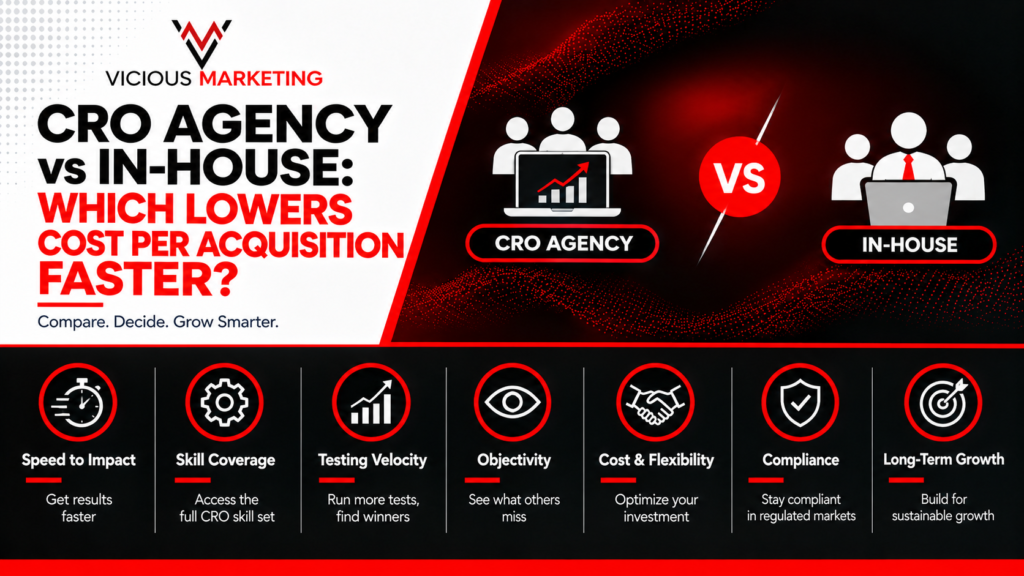
Here’s how in-house vs agency conversion optimization compares on the factors that drive speed and cost per acquisition.
| Factor | In-house | CRO agency |
| Time to first impact | Slow: hiring and ramp take months | Fast: starts with a process and known fixes |
| Skill coverage | Depends on headcount, often one generalist | All five disciplines bundled |
| Testing velocity | Limited by a small team | Higher, with a dedicated team |
| Tooling cost | Bought and managed separately | Often included, but check |
| Objectivity | Close to the product, can miss leaks | Outside view, fresh diagnosis |
| Accountability | Can drift toward activity | Tied to CPA and revenue, if contracted well |
| Product depth | Deep | Learned over time |
| Compliance in regulated markets | Depends on the hire | Strong only with a specialist |
| Total first-year cost | High fixed cost | Lower and more flexible, but varies |
The short read: in-house wins on product depth and long-term control. An agency wins on speed, breadth and accountability, which are the levers that move cost per acquisition.
Dimension by Dimension
1. Speed to Impact
Hiring takes months, and ramp-up takes more. You have to write the role, find the person, wait out a notice period and then give them time to learn your product and your data. Through all of that, the clock runs on wasted spend. A specialist agency starts with a process, tooling and a backlog of known fixes, so a first test can ship while an in-house hire is still onboarding.
Verdict: agency. Speed is the whole point when every month leaks CAC.
2. Skill Coverage
CRO needs five disciplines, and each one fails differently. Weak analytics means you test the wrong page. Weak copy means a good idea gets a tired variant. No developer means winning tests sit in a queue. In-house, you either hire five people or stretch one across everything. An agency brings the disciplines bundled, so no single gap stalls the programme.
Verdict: agency for breadth. In-house only matches it at real headcount cost.
3. Testing Velocity
Lower cost per acquisition comes from shipping and learning fast. More tests mean more chances to find a winner, and even a losing test teaches you something. A stretched in-house hire might ship one or two experiments a month, because they’re also doing research, design and QA. A dedicated team can ship weekly and run several in parallel when traffic allows.
Verdict: agency, on throughput, provided your traffic can support the volume.
4. Objectivity
The truth is, in-house teams are close to the product, and they inherit its assumptions. That makes them miss leaks that are obvious to an outsider, like a confusing pricing page or a form nobody questions anymore. If your problem is plenty of visitors and few customers, our post on traffic but no conversions shows what a fresh diagnosis looks for.
Verdict: agency, for a fresh pair of eyes.
5. Product Depth and Long-Term Ownership
Here in-house genuinely wins. Nobody knows your customers, product roadmap and internal politics like the people who live inside them. That context makes tests smarter over time, and the learnings stay in the building instead of walking out when a contract ends.
Verdict: in-house, for the long game.
6. Accountability
This is the real differentiator. An in-house team’s incentives can drift toward activity, like tests run and pages shipped. A good agency is accountable to a number, cost per acquisition and revenue per visitor, or it loses the contract. What most people miss is that activity feels like progress long before it shows up in revenue. Our guide to conversion leaks in paid traffic explains where the money actually escapes.
Verdict: a good agency, because its survival depends on the economics.
7. Compliance in Regulated Markets
In iGaming, finance and fintech, every test has to respect UKGC, FCA or ESMA rules. A generalist, whether in-house or agency, can ship a test you can’t legally run, like a bonus claim or risk-warning change that breaks the rules. Compliance has to be part of the testing process, not a check at the end.
Verdict: a specialist with compliance built in, wherever they sit.
When In-House Actually Makes More Sense
It would be dishonest to say an agency always wins. In-house is the better call when:
- You have enough traffic and test volume to keep a full team busy year-round, so the fixed cost pays for itself.
- CRO is core to your product, and you want the muscle in-house permanently.
- You already have the five skills and just need someone to coordinate them.
Even then, there’s a common hybrid. Bring in an agency to diagnose and build the system, then hand it to the in-house team to run. Many companies do exactly this, because it buys speed up front and ownership later.
Should I Hire a CRO Agency? How to Actually Decide
Skip the generic “it depends.” Ask these four questions:
- What’s a month of the current conversion gap costing you? Take an illustrative example: $20,000 of monthly spend wins 100 customers, a CPA of $200. A 25% lift in conversion at the same spend wins 125, cutting CPA to $160. That’s $40 saved on each of 125 customers, or $5,000 a month. Work out your own version. If the gap is large, speed wins, which points to an agency.
- Do you have all five CRO skills in-house today? If not, price a full team honestly. It usually costs more than a single hire suggests, and a single hire rarely covers the gap.
- Is this a one-time fix or a permanent function? A one-time fix points to an agency. A permanent, high-volume function points to in-house or a hybrid.
- Are you in a regulated market? That raises the bar on specialist experience, because a test that lifts conversion but breaks a rule can cost far more than it earns.
The through-line: the fastest path to a lower cost per acquisition is almost always diagnosing the leak first, then deciding who runs the fixes.
How Vicious Marketing Approaches This
We start by diagnosing where conversion is actually breaking and what fixing it is worth, before anyone commits to a build-versus-buy decision. It’s the approach behind the Vicious Marketing Operating System.
We report on cost per acquisition and revenue per visitor, not tests shipped. In regulated niches, every test is compliance-checked before launch, so a win is a win you can actually keep.
And we’re comfortable with the hybrid. We can fix the system and hand it over, or run it ourselves, whichever lowers your cost faster.
Find Out What Your Conversion Gap Is Costing, Before You Hire Anyone
You don’t have to decide between building and buying today. You just need to know what the gap is costing you.
Our free acquisition teardown maps your funnel, shows where conversion is breaking and puts a value on fixing it, so the build-or-buy decision rests on numbers instead of instinct. You get the stage that’s costing you the most, a prioritised fix list and what each fix is worth. If you end up building in-house, you’ll at least know what to build first.
Book Your Free Acquisition Teardown
Frequently Asked Questions
How much does a CRO agency cost vs an in-house team?
Published ranges vary. One guide puts agency retainers at roughly $5,000 to $15,000 a month, while Rework’s 2026 hiring guide shows mid-level in-house specialists at $75,000 to $105,000 base salary. That’s one person, before analyst, designer, developer and tools. Ask agencies what the retainer includes, then compare fully loaded costs.
How long before CRO lowers cost per acquisition?
First tests can run within weeks, but meaningful gains compound over months. Traffic matters too, since CRO relies on statistical validity, so low-traffic sites need longer to reach reliable results. Expect your agency or team to show early learnings quickly, then judge the programme on cost per acquisition over a quarter or more.
Can I use an agency to set up CRO and then bring it in-house?
Yes, and many companies do. The agency diagnoses the leaks, builds the testing system and documents the process, then your team takes over. Plan the handover from day one: agree on tooling, reporting and test backlogs up front, so nothing is lost when the agency steps back and your people start running tests.
Do I need a CRO agency if I already have a conversion rate optimiser?
Not necessarily. If your optimiser covers analytics, design, copy, development and testing, with a clear cost-per-acquisition target, you may be fine. An agency can still add capacity, an outside view or compliance expertise in regulated markets. Start by checking which of the five skills your current setup lacks.