Online Casino SEO: The 2026-27 Guide to Ranking a Casino and Winning Players

Your casino has hundreds of game pages, a decent domain and a licence. Yet affiliates outrank you for almost every term that brings in players.
Online casino SEO isn’t about ranking more pages. It’s about owning the few search layers where operators can win, and keeping them safe from penalties and licensing risk. This guide explains how casino SEO works in 2026-27, what to fix first and what a specialist team does differently. Our iGaming SEO strategy 2026 post covers the whole industry, while this one is built for casino operators. Everything below is the work our team delivers through our online casino SEO services.
1. What Online Casino SEO Actually Is
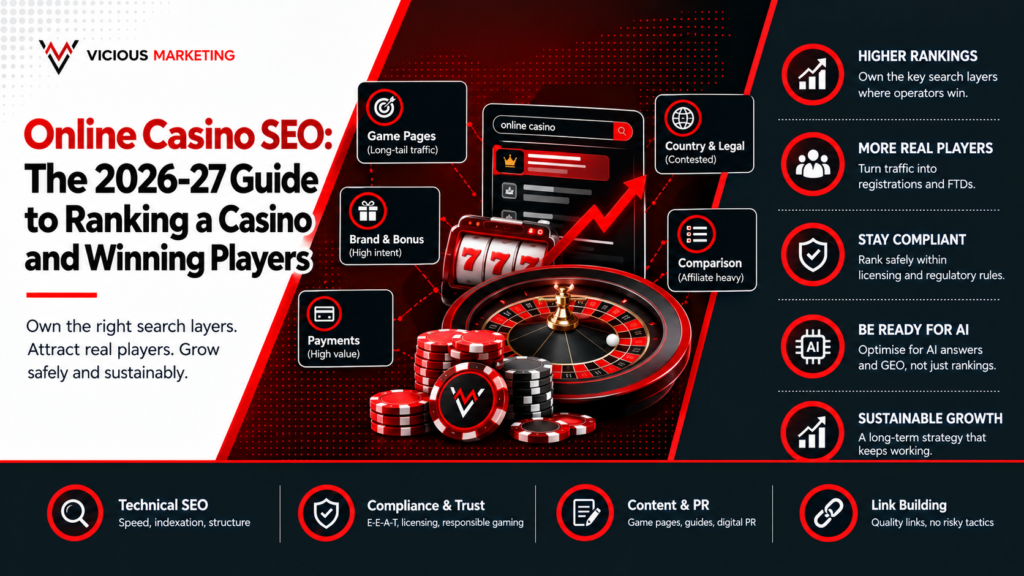
Most guides treat it as generic SEO with casino keywords. It isn’t. Casino search splits into five layers, and each has its own SERP, winner and page type.
| Layer | Example query | Usually ranks | Right page type | Conversion value |
| Game | [slot name] demo | Operators, providers | Game pages | Medium |
| Brand and bonus | [operator] free spins | Operators, affiliates | Brand and promo pages | High |
| Payments | casino with PayPal | Operators | Payment-method pages | High |
| Country and legal | online casino in [country/state] | Contested | Market hubs | High |
| Comparison | best online casino | Affiliates | Comparison pages | Medium to high |
Operators naturally win the game, brand and payment layers. Affiliates dominate comparison. Country and legal is the contested middle, and it’s where a good casino SEO strategy earns its keep.
2. Why Casino SEO Is Harder Than Almost Any Other Vertical
The constraints are invisible until you hit them. Licensing rules decide what you can say and where. Google treats gambling as a high-trust topic, so thin or anonymous content stalls. Paid media is restricted on most major platforms, so organic carries more weight than in other industries. And affiliate sites have years of authority behind them.
The truth is, this is why generic playbooks underperform here, and why vertical experience matters.
3. Site Architecture: The Foundation Most Casinos Get Wrong
A casino site is a lobby, a library and a legal map at once. You need game category hubs (slots, live casino, table games, jackpots), provider pages, individual game pages, payment-method pages, country or state pages and a clear bonus-terms structure.
The best performers give every game and hub one stable, indexable URL and link between them in a logical hierarchy. Faceted filters and infinite scroll in the lobby often create thousands of duplicate or unindexable URLs. So map your hubs before building more pages, consolidate near-duplicate filter URLs and make sure Google can reach game pages through plain links, not only through scripts.
4. Game Pages and Content That Actually Rank
A game page isn’t just an embed. It’s your main long-tail asset. Give it a unique description covering RTP, volatility, features, provider and how it plays. Add demo mode where permitted, similar-game links, responsible-gambling messaging and clear terms for any promotion shown.
What most people miss is how low the bar is. Copy-pasted provider descriptions are the norm, so genuinely useful game content stands out. Educational guides on how slots work, what RTP means or how live dealer games run also build the trust that supports every other page. One warning: keep bonus claims accurate and aligned with local rules. Misleading terms are a compliance risk, not just an SEO one.
5. Technical SEO for Casino Platforms
Casino platforms are heavy, script-driven and slow by default. Watch JavaScript-rendered lobbies, Core Web Vitals on mobile, crawl budget across large catalogues, canonical and hreflang setup across markets, structured data and geo-blocking behaviour.
Geo-restrictions can create hidden SEO challenges. If search engines see something different from what players in a market see, or get blocked entirely, rankings suffer and it can look like cloaking. For the details, see our guides on hreflang mistakes and common iGaming SEO mistakes.
6. Compliance, Trust and E-E-A-T by Market
Compliance is part of SEO here, not another team’s problem. That means licence and regulator details, named authors, an editorial policy, responsible-gambling tools and age gating. It also means respecting market-specific rules across the UK, EU countries, US states and newly regulated markets such as Brazil.
The same page may be fine in one market and non-compliant in another. A scalable programme builds those rules into content templates from the start.
7. Link Building and Digital PR Without the Risk
Paid placements and private networks are the easy route, and the most exposed. Google has tightened its spam policies, and gambling is one of the categories most exposed to enforcement. Links built to move fast can become a liability the moment an update lands.
Audit your current backlinks for risky patterns first. Then shift to data-led digital PR, original research, expert commentary and real partnerships. Our posts on iGaming link building show what that looks like.
8. Search Is Changing: AI Answers and GEO
Players now ask AI assistants “is [casino] legit?” and “how do slots work?” AI search favours clear, sourced, well-structured answers and consistent brand information across the web. For casinos, a trustworthy entity (licence, ownership, reviews) matters as much as keywords.
Structure educational content so it’s quotable, keep licensing details consistent everywhere and track AI visibility alongside rankings. Read why you need both in SEO vs GEO.
9. Measuring Casino SEO by Players, Not Sessions
This is the report that decides whether SEO keeps its budget. Traffic can rise while first-time deposits stay flat. The useful questions are which pages, markets and intent layers produce registrations and FTDs, and what those players are worth over time.
Report organic by landing page, market and intent layer through to first deposit, and track brand and non-brand separately. Our UK casino case study shows how that connects SEO to acquisition cost.
10. What We Do: Our Approach to Online Casino SEO
As a casino SEO agency focused on iGaming, we keep it specific:
- Audit: technical health, indexation, architecture, content gaps and backlink risk across markets.
- Roadmap: a prioritised plan tied to your licences, markets and player value.
- Execution: game and hub content, technical fixes, digital PR and link building, and structured data.
- AI search: visibility in AI answers, not just classic rankings.
- Reporting: organic performance through to registrations and FTDs.
11. How We Can Help: Is This You?
You might recognise yourself here:
- Launching in a new regulated market and building visibility from scratch.
- Ranking behind affiliates for terms you should own.
- Hit by a core or spam update and needing a safe recovery plan.
- Running an in-house team that needs specialist support, not a replacement. Our post on an iGaming SEO company vs agency can help you weigh that.
- Choosing an agency and wanting to know what to look for. Start with how to choose an iGaming SEO agency.
Where to Start
Most casinos don’t need more pages. They need the right ones, a safe foundation and reporting that ties organic to players. If you want to see where organic is leaking and what to fix first, book an iGaming SEO audit through our iGaming SEO services page.
Frequently Asked Questions
What is online casino SEO?
It’s improving a casino’s organic visibility through site architecture, game and hub content, technical performance, trust signals and compliant link building.
How long does online casino SEO take to work?
Early movement often appears within a few months. Meaningful growth typically takes six to twelve, depending on domain strength, competition and technical cleanup.
How much does online casino SEO cost?
It depends on markets, site size and competition. The main price drivers are scope, number of markets, link building and content volume.
Can a casino outrank affiliates for “best online casino”?
It’s difficult, since those SERPs favour comparison publishers. Most operators win first on game, brand, payment and country pages.
Is it better to hire an agency or build in-house?
There is no one solution that fits in all conditions here. It actually depends on resources and speed, and many casinos use even both.