7 Hidden Costs Quietly Inflating Your Customer Acquisition Cost

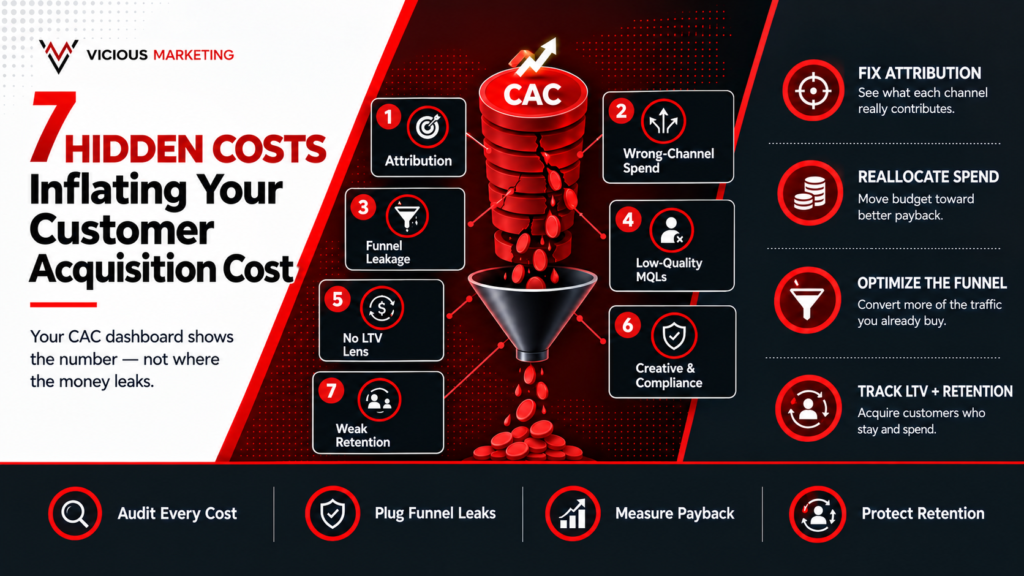
Your customer acquisition cost is too high, and the dashboard isn’t helping. It shows you the number, but not where the money actually leaks. Here’s the thing: CAC isn’t one cost. It’s a stack of hidden ones, and cutting the right line items brings it down without cutting growth.
Below are the seven costs hiding inside your number, plus what removing each one is worth. Finding which ones are inflating your number is exactly what our customer acquisition services are built to do.
1. Broken Attribution
When attribution is off, you credit the wrong channels and keep funding the losers. A channel that merely closes the sale gets the glory, while the one that started the journey looks useless and loses budget.
Why it hides: last-click reporting looks tidy and confident, even when it’s quietly wrong.
How to cut it: fix the model. Move beyond a single touchpoint, compare what each channel actually contributes and test your assumptions with controlled experiments where you can. We walked through one real example in our attribution model case study.
2. Wrong-Channel Spend
The budget has a habit of sitting where it’s always sat. Meanwhile, some channels pay back slowly or not at all, and others quietly deliver customers at a fraction of the cost.
Why it hides: inside a healthy-looking blended customer acquisition cost, strong channels mask weak ones. The average looks fine while individual line items bleed.
How to cut it: break CAC out by channel and by payback period, then reallocate toward the leaders. Keep a small test budget for new channels so you’re not just reinforcing yesterday’s habits.
3. Funnel Leakage
Funnel leakage is one of the major reasons for high customer acquisition cost. Paid traffic that never converts means you’re paying for the same customer twice: once for the click and again when you chase a replacement. Every leak between click and conversion pushes your effective CAC up.
Why it hides: it looks like a traffic win. Visits are up, reports look busy and nobody asks how many of those visitors ever had a real chance of buying.
How to cut it: plug the funnel before you buy more traffic. Look at message match, page clarity, friction and trust at the point of decision. Our conversion optimization services focus on exactly this kind of recovery.
4. Chasing MQLs Over SQLs
A pipeline stuffed with marketing-qualified leads feels like progress. But if those leads do not turn into sales conversations, you’re paying a premium for leads that don’t close.
Why it hides: the pipeline looks full, so everyone assumes things are going well. The cost shows up later, when revenue lags behind lead counts.
How to cut it: optimize toward revenue events rather than form fills. Feed back closed-won data, sales-accepted leads and pipeline value to your ad platforms and reporting. A strong performance marketing agency will set campaigns up around outcomes like these instead of surface-level metrics.
5. No LTV Lens
Here’s what most people miss: Customer acquisition cost on its own tells you almost nothing. A low CAC can still be a bad deal if those customers leave quickly or spend little, while a higher CAC can be excellent if they stay and grow.
Why it hides: CAC is measured at the moment of purchase, but customer value plays out over months or years. Looking at one without the other gives a misleading picture.
How to cut it: judge CAC against lifetime value, not in isolation. Segment customers by value, then shift budget toward the sources that bring in the people who actually stay and spend.
6. Creative and Compliance Rejections
In regulated verticals such as finance, health or gambling, ads can be rejected, campaigns paused and creative sent back for another round of approvals. Each delay costs time, wasted production and lost momentum.
Why it hides: teams treat it as normal operational drag. It never appears as a line item, but it eats budget through rework and downtime.
How to cut it: build compliant-by-design creative. Bring legal and compliance input into briefs early, keep a living checklist of platform and regulator rules and reuse approved patterns so every new ad doesn’t start from scratch.
7. Flat Retention and Weak Onboarding
If customers churn quickly, you have to keep replacing them, and your effective cost of keeping a customer base balloons. The truth is, a leaky bucket makes every acquisition dollar work harder than it should.
Why it hides: it sits downstream of marketing, so it rarely lands on the acquisition team’s dashboard. Still, it directly affects how long it takes a customer to pay back what you spent winning them.
How to cut it: improve payback by improving retention. Tighten onboarding, make the first success moment arrive sooner and watch early churn closely. Even small gains here can lower your effective customer acquisition cost without touching ad spend.
Find the Costs Hiding in Your CAC
Most teams carry three or four of these at once, and the dashboard averages them into one misleading number. That’s why a single headline CAC can feel so impossible to act on.
Our Acquisition Teardown breaks your CAC into its real line items and cuts each one, so you know exactly where to start. Explore our customer acquisition services to see how it works.
Frequently Asked Questions
What’s actually included in customer acquisition cost?
At its simplest, CAC is the total cost of winning new customers divided by the number acquired in a period. That usually includes ad spend, but also agency or contractor fees, marketing tools, creative production and the share of salaries tied to acquisition. Teams define it differently, so agree on one definition and stick to it.
Why is my CAC high even when campaigns look efficient?
Channel-level metrics can look great while the overall number stays high. Common reasons include attribution errors, funnel leakage, low-quality leads that don’t close, hidden production and compliance costs and customers who churn quickly.
How do you lower CAC without cutting spend?
Improve what happens to the traffic you already buy. Fix attribution, move budget to channels with better payback, plug funnel leaks, optimize toward revenue events and strengthen retention. Each of these can reduce effective CAC while keeping growth intact.
What’s a good LTV:CAC ratio?
The most commonly suggested is around 3:1. It means a customer is worth roughly three times of the cost to acquire them. The right ratio varies according to business model, margins and cash flow. So, you must treat it as a starting point rather than a rule.