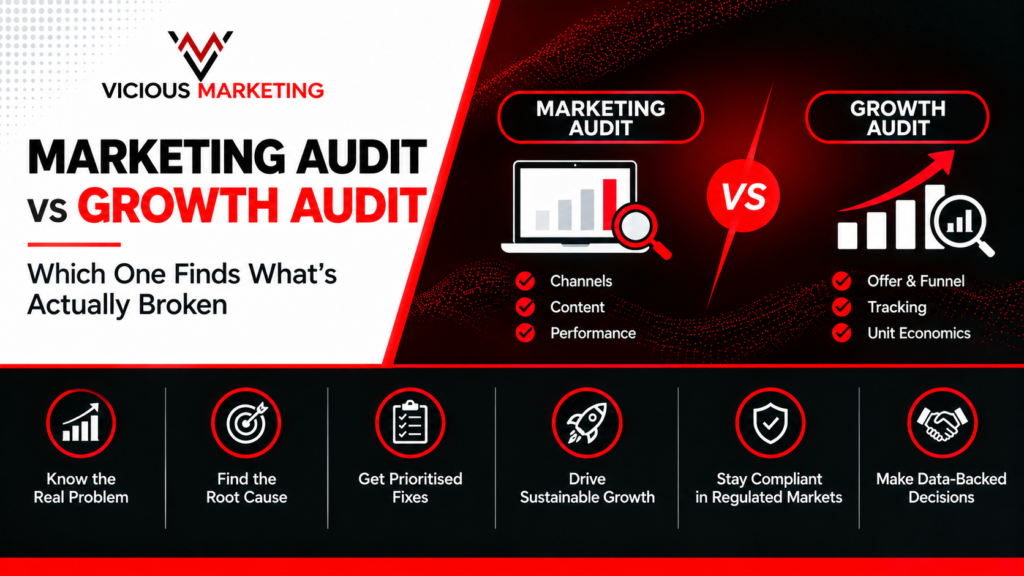
Marketing Audit vs Growth Audit: Which One Finds What’s Actually Broken

Growth has stalled, so you commission an audit. Three weeks later you get a 60-page deck on your ads and SEO, and growth still hasn’t moved.
Here’s the thing: most audits check marketing activity. But the problem is often somewhere else entirely, like the offer, the funnel, the tracking, the unit economics or a compliance constraint. This post covers what a marketing audit and a growth audit each include, what each one misses and how to tell which one you need. If you’d rather skip ahead, our free Acquisition Teardown answers that question for your business.
What Is a Marketing Audit?
A marketing audit is a structured review of your marketing activity, including channels, SEO, paid media, content, social and brand consistency, to find what to improve. It assumes the business model works and asks how well marketing is executing.
Typical scope covers channel performance, search visibility, ad accounts, content quality and brand consistency. It’s good for tuning channels that already work. If your paid search is decent but sloppy, or your SEO has obvious technical gaps, a marketing audit will find them. You can estimate your technical SEO audit cost with our free calculator.
What it misses is everything upstream and downstream of marketing. It assumes the offer is right, the funnel converts and the numbers add up. When those assumptions are wrong, a marketing audit polishes the wrong thing.
What Is a Growth Audit?
A growth audit is a review of your entire growth system, from offer and pricing through funnel, channels, tracking and unit economics, to find the root cause of stalled growth and rank the fixes by value.
It covers the offer, pricing, the funnel, channels, tracking and attribution, and unit economics like CAC, LTV and payback. It’s good for finding why growth stalled when nobody can explain it. The question isn’t “how are our channels doing?” but “what’s actually limiting growth?”
Marketing Audit vs Growth Audit: Side-by-Side
| Marketing audit | Growth audit | |
| Starting question | How well is marketing performing? | Why isn’t the business growing? |
| Scope | Channels, content, brand | Offer, funnel, channels, tracking, unit economics |
| Who it’s for | Teams with a working model who want tuning | Teams with stalled or unexplained growth |
| What it measures | Activity (traffic, rankings, engagement) | Economics (CAC, payback, LTV:CAC) |
| Typical output | Channel-level fixes | Root cause and a prioritised fix list |
| When to use it | Routine health check, channel optimization | Plateau, rising costs, unclear attribution |
5 Signs You Need a Growth Audit, Not a Marketing Audit
The truth is, the symptoms of a growth problem often look like marketing problems. These five suggest you need to look wider:
- Growth stalled and nobody can explain why. If every channel looks “fine” but revenue is flat, the issue probably isn’t a channel.
- Spend went up but revenue didn’t. Costs may be hiding in places your reports don’t show. See the hidden costs of customer acquisition.
- Traffic is fine but conversions aren’t. More visitors won’t fix a leaky funnel. Our post on traffic with no conversions explains why.
- You’ve already switched agencies and the problem came back. A new agency can’t fix a problem that sits outside marketing.
- You can’t tell which channel brings in paying customers. If attribution is broken, every budget decision is a guess.
What a Good Growth Audit Should Find
A solid growth audit looks at five areas.
Offer and positioning leaks. Is the offer clear, differentiated and priced in a way buyers accept? Sometimes the real issue is that the market doesn’t see why it should choose you.
Funnel leaks. Where do qualified prospects drop off between first touch and paying customers? Small leaks at several stages add up to a big gap. Our guide to conversion leaks in paid traffic shows what to look for.
Channel mix and spend allocation. Are you putting money where the marginal return is highest, or where last quarter’s habits point?
Tracking and attribution gaps. What most people miss is that bad data doesn’t just hide problems, it points you at the wrong ones. If you can’t trace revenue to source, you’ll cut the channels that work.
Unit economics. CAC, payback and LTV:CAC tell you whether growth is healthy or just expensive. A business can grow quickly and still lose money on every customer.
A good audit ends with a ranked fix list and what each fix is worth, not a deck.
Why It Matters More in Regulated Markets
In iGaming, CFD and forex, and fintech, a standard marketing audit can recommend tactics your licence won’t allow. An aggressive bonus offer, a particular claim in ad copy or a retargeting approach might look great on paper and break the rules in practice.
A growth audit has to factor in the constraints of regulators like the UKGC, MGA, FCA and ESMA, or its fixes can’t be used. That’s a big reason recommendations in these sectors need to be built around compliance from the start, not checked afterward.
For a real example, see our UK casino case study, where cost per first deposit fell 18%.
How the Vicious Marketing Acquisition Teardown Works
Our Acquisition Teardown is a growth audit built on the Diagnose stage of the Vicious Marketing Operating System. It follows three steps:
- Map the growth model. We lay out how customers move from first touch to revenue, and where the numbers sit.
- Find where it leaks. We look for the biggest gaps in the offer, funnel, channels, tracking and economics.
- Price the fix. We estimate what each fix is worth, so you know where to start.
You get the root cause, a prioritised fix list and the value of each fix.
Find Out What’s Actually Broken
If you’re not sure whether it’s a marketing problem or a growth problem, that’s exactly what the teardown answers.
Book Your Free Acquisition Teardown
Frequently Asked Questions
What’s the difference between a marketing audit and a growth audit?
A marketing audit reviews channels and marketing activity, assuming the business model works. A growth audit reviews the whole growth system, from offer to unit economics, to find the root cause of stalled growth.
What does a marketing audit include?
Typically channel performance, SEO, paid media, content, social and brand consistency. It’s best for tuning channels that already work.
How much does a marketing audit cost?
It depends on scope, site size and the number of channels reviewed. Our technical SEO audit cost calculator gives a starting estimate for the SEO portion. [Cross-link to the cost post once live.]
How long does a growth audit take?
It depends on how complex your funnel is, how many channels you run and how clean your data is. Better tracking and access to accounts speed things up.