Why Your Customer Acquisition Cost Is Rising and How to Fix It

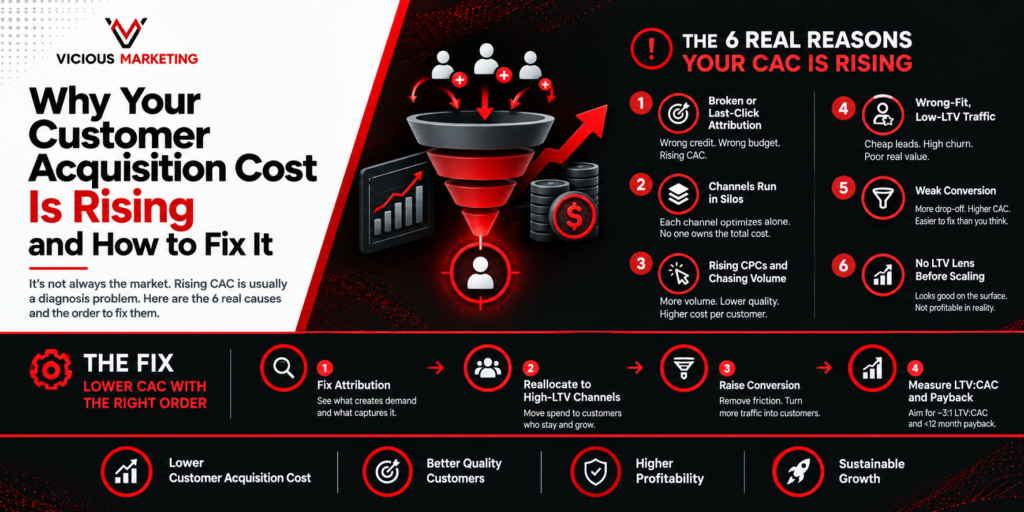
Customer acquisition cost rising quarter after quarter, with no one able to say why, is the problem that lands on our desk most often. The instinct is to look at the ad accounts. But rising CAC is rarely a “spend more” or “bid smarter” problem. It is a diagnosis problem. Until you know which part of the acquisition system is leaking, every fix is a guess, and guesses get expensive. Below are the six real causes and the order in which to fix them.
What “Rising CAC” Actually Signals
Customer acquisition cost is the total sales and marketing spend needed to win one new customer. When that number climbs, the common explanation is that the market got harder: more competition, higher costs, tighter budgets.
Sometimes that is part of it. More often, a rising number means the economics behind acquisition have broken. Attribution is crediting the wrong channels, traffic is arriving that was never going to pay back, or the funnel is converting less than it used to. The market did not suddenly change. The system stopped working, and the CAC figure is only the symptom.
The 6 Real Reasons Your Customer Acquisition Cost Is Rising
1. Broken or Last-Click Attribution
If your reporting gives credit to the last click, it rewards the channels that close and punishes the ones that create demand. Budget drifts toward branded search and retargeting, which look cheap, while the channels that fill the top of the funnel get starved. CAC then rises as the cheap demand runs out. You cannot fix what you are measuring wrongly.
2. Channels Run in Silos
Paid media, SEO, email and lifecycle each report their own numbers, often owned by different people or agencies. Each one optimizes for its own metric. Nobody owns the blended cost of winning a customer, so the same buyer gets paid for twice, and no one notices the total climb.
3. Rising CPCs and Chasing Volume
Click costs do rise in competitive markets, and that is real. The mistake is responding by chasing more volume at any price. When the target becomes more leads, teams widen targeting, loosen quality and accept worse traffic to hit the number. Volume goes up. So does the cost of every customer that actually pays.
4. Wrong-Fit, Low-LTV Traffic
Not every customer is worth the same. Traffic can look cheap per lead and still be expensive per profitable customer, if those customers churn quickly, buy once or never reach a second purchase. A CAC that looks acceptable on the dashboard can be a loss once you include what those customers are actually worth.
5. Weak Conversion
If the page, offer or onboarding loses more people than it should, every click costs more in the end. A drop in conversion rate raises CAC just as surely as a rise in CPC, and it is usually cheaper to fix. Forms that ask too much, slow pages, unclear offers and friction at the deposit or trial step all quietly raise the price of each customer. Systematic conversion optimization tests those points against CAC and LTV targets, not against vanity metrics.
6. No LTV Lens Before Scaling
Many teams scale a channel because the CAC looks good, without checking lifetime value or payback. By the time the numbers show the customers were never profitable, a large amount has been spent. Without LTV in the decision, you can grow fast and lose money on every new account.
Why Scaling Spend Makes It Worse
When CAC rises, the temptation is to spend more to hit the growth target. But more budget on unvalidated economics just buys more of the same loss.
Platforms also push back as budgets grow. As you increase spend on a channel, you reach less qualified people, and the marginal customer costs more than the average one. If the underlying problem is attribution, fit or conversion, higher spend scales the problem, not the result. The right order is to fix the economics first and scale second.
How to Actually Lower a Rising CAC
Lowering CAC is a sequence, and the order matters.
Fix attribution first. You need to see which channels create demand and which only capture it. Without that, reallocating the budget is guesswork.
Reallocate to high-LTV channels. Move spend toward the sources that bring customers who stay and expand, even if their upfront cost is higher. A slightly higher CAC for a much more valuable customer is a better deal.
Raise conversion. Improving conversion across the funnel lowers CAC without spending another dollar on traffic.
Measure against LTV:CAC and payback. A common rule of thumb is an LTV:CAC ratio of about 3:1, though it varies by business. A simple illustration: a customer worth $900 in lifetime gross margin and costing $300 to acquire gives 3:1. Cut CAC to $240 and the ratio rises to 3.75:1. Payback, the months needed to recover CAC from a customer’s margin, shows how long that cash is at risk.
This is the work behind our customer acquisition services: diagnose the true CAC, LTV and payback before spending, then run every channel against one target.
We have seen the effect in practice. For a fintech SaaS company, blended CAC fell from about $5,000 to about $2,800, a 44% reduction, while ARR grew from roughly $5M to $25M in under a year. For a UK casino operator, cost per first deposit fell 18%, from $170 to $139.40, by month five on unchanged spend.
Running Acquisition as One System: The VM Approach
Most operators cannot solve this in-house because the problem crosses teams. Attribution sits with analytics, channels sit with agencies, conversion sits with product, and nobody owns the whole.
The VM Operating System treats acquisition as one system with three stages: Diagnose, Engineer and Scale. We start by finding where the economics leak. We then engineer the fixes across attribution, channels and conversion. Only then do we scale, with every channel measured against one CAC target.
It also fits regulated markets, where compliance shapes what you can say and test. We build with those constraints from the start, in sectors such as iGaming and finance (CFD/forex), so growth does not create regulatory risk.
See exactly where your CAC is leaking: book a free Acquisition Teardown.
Prefer to start with the framework? Get the Regulated Market Acquisition Playbook.
FAQ
Why is my customer acquisition cost increasing?
Your customer acquisition cost is usually increasing because the economics behind acquisition have broken, not just because the market got harder. Common causes are broken attribution, siloed channels, volume chasing, low-LTV traffic, weak conversion and scaling without an LTV check. A diagnosis shows which one applies to you.
What is a good customer acquisition cost?
A good CAC is one your customers pay back comfortably. There is no universal number. A common rule of thumb is an LTV:CAC ratio of about 3:1 and payback within 12 months, though both vary by industry and business model. Judge CAC against lifetime value and payback, never in isolation.
How do you reduce customer acquisition cost?
Fix attribution so you can see what works, move budget toward channels that bring high-LTV customers, and raise conversion across the funnel. Then track LTV:CAC and payback to confirm the gains. Reducing CAC works best when channels are managed against one shared target.
Does rising CAC mean I should cut ad spend?
Not automatically. Cutting spend can lower the headline cost while shrinking growth, and it does not fix the cause. First diagnose why CAC is rising. If the economics are sound, scale carefully. If they are not, fix attribution, fit and conversion before adding or removing budget.